
Summer on the Battlefields
Under steady rain at Antietam, students bring Civil War history to life by walking the grounds, analyzing strategies, and connecting with the soldiers whose stories still echo across the battlefield.
The rain seemed appropriate. The second day of the HI230 [Civil War Staff Ride] battlefield trip brought the group of seven Norwich students to Sharpsburg, Maryland, and the Antietam battlefield. Well known as the bloodiest single day in American military history, thousands of men perished here at locations such as the Cornfield and the Bloody Lane.
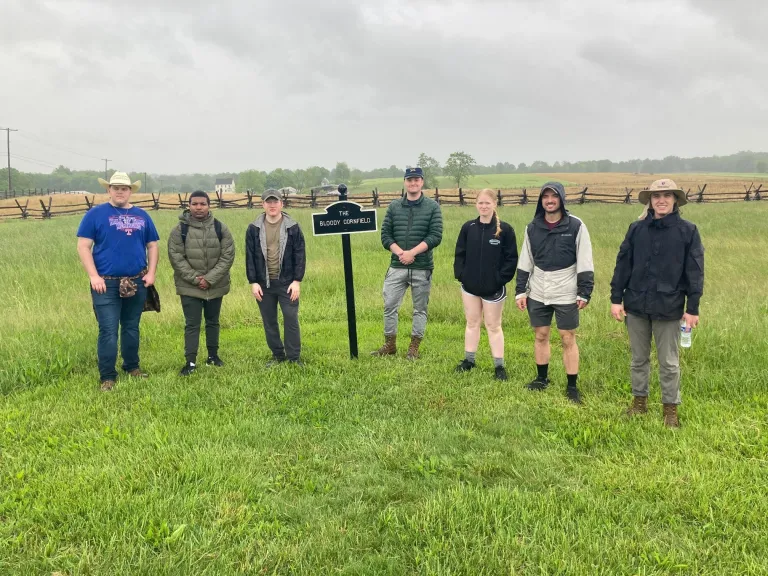
Our group arrived shortly after dawn with the plan of walking the battlefield in as close to real time as possible. Though the battle had been fought on a warm and humid September day, it was pouring rain by the time we arrived at the battlefield, and it would not let up for most of the day. Gathering up our packs and rain gear, we started at the northern end of the field. We started at the Mumma Farm, following the Union attack in as men from General “Fighting” Joe Hooker’s corps struck through the East Woods and into the Confederate lines at the Cornfield. From there, we followed the fighting into the West Woods, where Union forces were struck by a fierce counterattack by men under Thomas “Stonewall” Jackson.
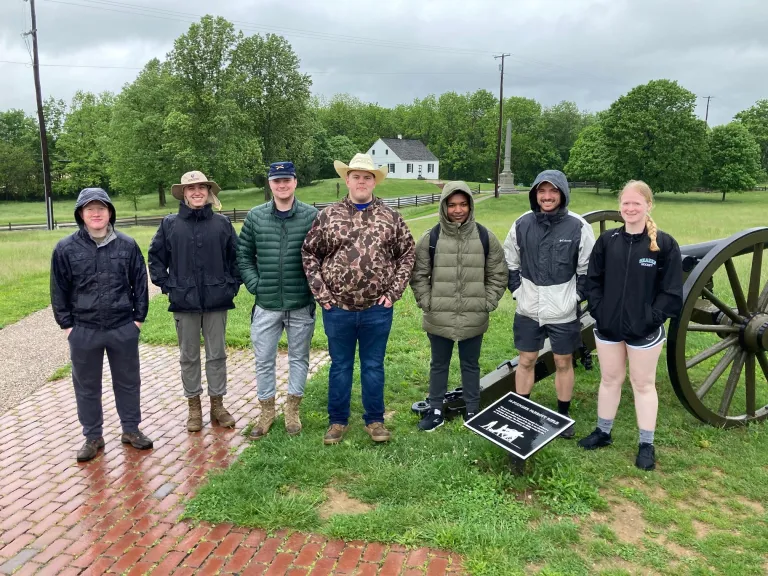
Students in the class had been assigned various officers and men who had fought in this battle. As we walked, the group discussed their soldiers' experiences while we assessed the command decisions made by officers ranging from Army commanders down to captains in command of companies. By late morning we had covered the first phase of the battle and were thoroughly drenched; we found shelter in the tiny, modest Dunker Church, which had amazingly survived the battle relatively intact despite being an aiming point for artillery fire from both sides of the field (though it would not survive a wind storm in the 1920s; the current one there is a recreation). Wounded soldiers of both sides had also sought shelter here during the battle. As we paused to reflect on lessons learned, our soaked-to-the-bone misery made for a suitable starting point for analyzing the suffering of those who had fought on these fields.
The HI230: Civil War Staff Ride class has been offered annually at Norwich University for more than 15 years now. Designed after the classic “staff ride” model established by the Prussian military in the 19th century and utilized by military forces across the globe, the course is a Maymester experience that occurs immediately following the end of the spring semester. Students spend the first and third weeks completing online assignments and research, with the middle week being a trip to the major battlefields of a specific Civil War campaign. The trip week is built around five full days spent walking the battlefields in question, rain or shine (May usually has a mixture of both).
The class is not a mere tour of battlefield landmarks; despite being a proud National Park Service Junior Ranger in my youth, the goal is not to walk, talk, and point. Before setting foot on the battlefields, students review materials on nineteenth-century battle tactics, along with details on the major units and commanders involved, so they can actively contribute to our discussions. Students are also assigned specific members of those forces, usually one Union and one Confederate soldier, who they follow throughout the campaign. The goal here is, as historian William Robertson noted, the linking of “a historical event, systematic preliminary study, and actual terrain to produce battle analysis in three dimensions.” While the dated tactics of the era may offer limited lessons for a 21st-century warrior, there is tremendous value in examining the command decisions and combat leadership of American officers who, at the time, were not much older than the average Norwich student.
Each year, the class examines one of three sets of campaigns: the Peninsula Campaign of 1862, the Antietam and Gettysburg Campaigns, or the Overland Campaign of 1864. This rotation allows the instructor to keep things fresh and for students to take the class more than once to learn about a different campaign. Each class and its topic are distinct in their own way.
The Peninsula Campaign class is based in Richmond, Virginia, and from there the group travels to learn about General George McClellan’s failed effort to take the Confederate capital in 1862. Starting near the tip of the James River peninsula at the still impressive Fortress Monroe, we follow the operations through Yorktown (where the Confederates repurposed British entrenchments from 1781 to hold up the Union advance), to battles like Gaines’ Mill and Savage’s Station (where Vermonters, including Norwich graduates, helped defend the rear of the retreating Union army), and finally to Malvern Hill (where General Robert E. Lee launched a disastrous frontal assault that foreshadowed Pickett’s Charge a year later).
The Antietam and Gettysburg class is a popular one, for obvious reasons. Based out of Gettysburg, Pennsylvania, for the week, we travel out to Antietam and some of its preliminary battles the first two days before spending the final three days of the trip doing a day-by-day examination of Gettysburg. Fighting busloads of children and the occasional group Segway tour group, we hit all of the significant moments of the battle, giving particular attention to Norwich’s contributions to the fight, including Captain James Hall’s (Class of 1843) Maine artillery holding up the Confederate advance on McPherson’s Ridge on the first day and Major Edmund Rice (Class of 1860) earning the Medal of Honor for his role in the defense against Pickett’s Charge on the third day.
The third campaign class, the Overland Campaign of 1864, is a personal favorite of mine. I spent years researching the soldiers in that campaign and studying how they responded to the horrific combat at battles like Spotsylvania in Virginia, as well as their adjustment to the gradual introduction of trenches in Civil War battles. This research resulted in my 2017 book “The Army of the Potomac in the Overland and Petersburg Campaigns,” and unsurprisingly, the battles of this campaign remain among the most compelling to me. This is the campaign set for the upcoming summer, and I am already gearing up for the return to such locations as the “Mule Shoe” at Spotsylvania Court House and “Fort Hell” at Petersburg, Virginia.
Having taught these classes for so long, the trip has become quite familiar to me, but each year a different group of students helps keep things fresh and surprising. The class size is small, with typically around five to ten students each year. Students travel on their own to our base location, but during the week, I drive everyone around from point to point in a well-branded Norwich van. Through the years, we have had many adventures and an accident or two, but fortunately, no disasters. With so much time in the woods and on trails, we have had encounters with the region's flora and fauna, and poison ivy and ticks have left their mark (sometimes literally) over the years. Despite the grim nature of our studies, there have still been the occasional humorous moments. One year, a student was gazing down the barrel of a cannon on the Gaines’ Mill battlefield when he learned the hard way that birds like to use those barrels for nests. An alarmed bird swooped out, bashing into the student’s forehead and leaving a mark that lasted the week. Then there was the year when a large (non-venomous) snake slithered through our group discussion at the Wilderness, and the students decided, over their instructor's objections, to capture it. Despite the efforts of half a dozen of Norwich’s best and brightest, the snake escaped.
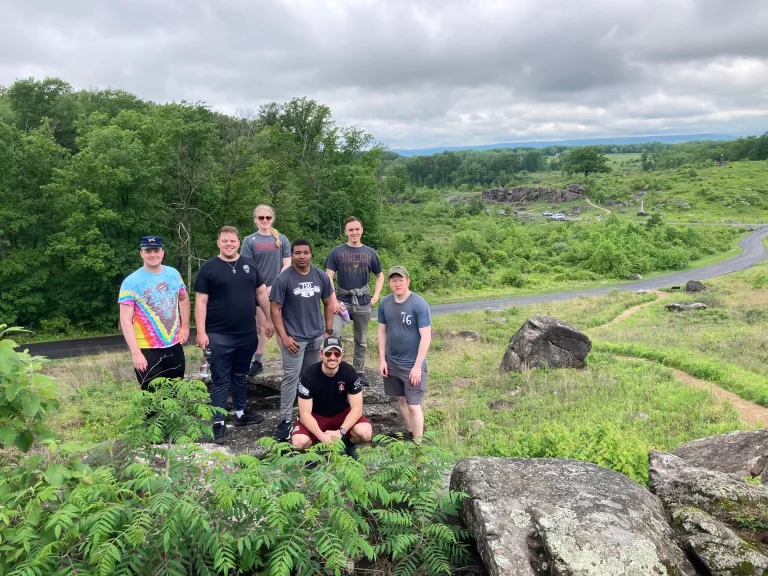
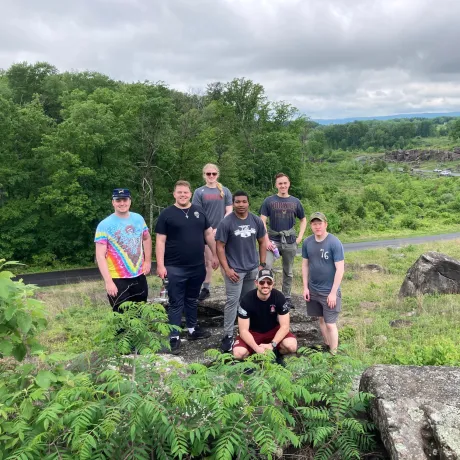
Last summer, it was Antietam, Gettysburg, and the rain. The weather cleared for the back half of the week, which gave us nice days for Little Round Top and Pickett’s Charge. But Antietam was the grim, relentless rain, made all the worse because it was our longest day, with about 12 hours spent out on the battlefield. After our pause at the Dunker Church, we headed back out to follow the back-and-forth struggle for the Sunken Road in the middle of the Confederate position, before turning down to the bridge on the Confederate right flank that stymied Union forces under General Ambrose Burnside for much of the day.
By the end of our day, we were all exhausted. Still, we made sure to pay our respects at the Antietam National Cemetery, where about 5000 American servicemen are buried. It was there that Robert Agnone ’27, a Norwich history major from Massachusetts, was able to locate the grave of Captain Werner von Bachelle, whom Robert describes as “a German immigrant who was killed at the Battle of Antietam alongside his dog.” Robert had been following several soldiers in the battle throughout the day, and one of them told the story of how, when Captain von Bachelle was killed in the cornfield, his beloved canine companion refused to leave his body and would end up dying alongside his master.
“Following the command decisions and the flow of battle was very informative as a contracted Army cadet. Also, being able to travel to the battlefields and follow events with an assigned soldier and his memoirs made the history personal. Recalling from their writings where they fought on the actual ground was very special. Visting the graves of soldiers that were mentioned by them was a touching and sobering experience, namely a German immigrant officer who was killed during the Battle of Antietam alongside his dog.” — Robert Agnone ’27
For Robert, hearing the stories told by his soldiers was one thing, but “visiting the graves of soldiers that were mentioned by them was a touching and sobering experience.” Ultimately, while students in the class learn a variety of lessons about terrain, tactics, and combat leadership, it is often the individual stories and experiences of soldiers on the battlefield that leave the most lasting memories.
Read More
Architecture in Action: Students Present During Homecoming
By NU Marketing & Communications Office
Architecture students present their work during Homecoming, one of the University's busiest weekends on campus.
2 min read
2026 Military Writers’ Symposium: How Cinema Shapes Our Perception of War
By Zack Bennett
Two days of programming on media and war features student research, expert panels, and a look at Darby’s Rangers.
3 min read

School of Architecture and Art to host John Cays
By NU Marketing & Communications Office
A subject-matter expert brings his expertise to Chaplin Hall on the Northfield campus.
2 min read