
From Service to the Screen
After an early setback forces him to rethink his future, Bailey Beltramo '17 finds his calling in filmmaking and storytelling, eventually returning to Vermont to tell a story rooted in community and belonging.

Rarely are paths through young adulthood linear. Bailey Beltramo ’17 quickly learned that his path would take some unexpected turns when he began his freshman year at Northeastern University in Boston. “I had an Army ROTC contract for nursing and that was the plan. That’s what I thought I wanted to do, but within a semester that kind of fell apart,” he says. “The downtown urban city life was not a good fit for me.”
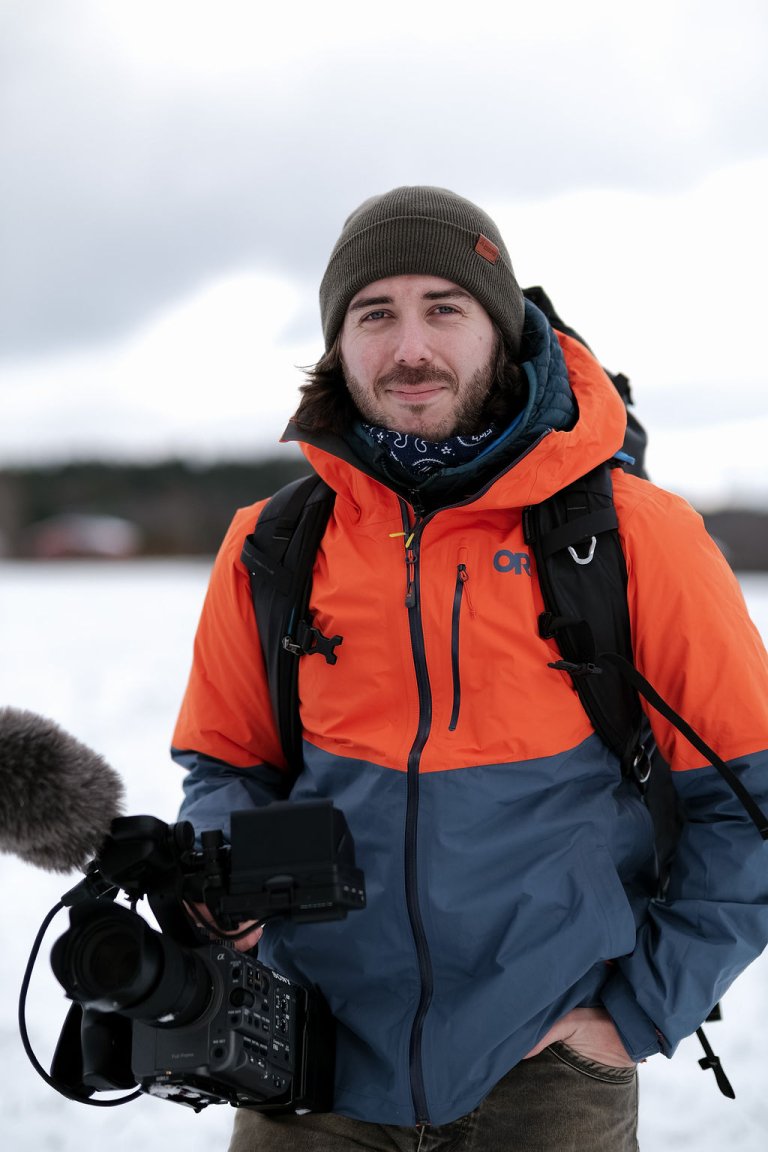
Beltramo grew up in small-town New Hampshire and says he had the “classic high school rebellious energy” that led him to run away to a big city. He quickly learned that this was not the environment he would thrive in. “I got my butt handed to me. Frankly, I was in over my head,” he says. “It became clear after the first semester that the program itself and location were not quite the fit I was hoping for.”
He knew he had plans to serve but quickly found out the atmosphere at a larger school that did not focus on the military aspects did not fit his needs. “You sure as heck stood out when you were trying to run mil labs in Fenway Park and people are walking through your mock ambush lane,” says Beltramo. “I didn’t necessarily like that split and at that time I was so focused on the military piece of it, I thought, ‘If I’m going to do this, I just want to do it all the way.’”
Beltramo began revisiting some options he had considered prior to enrolling at Northeastern. He had previously applied to Norwich and was accepted; he began considering the school again and eventually decided that he wanted to go to Northfield. “I got in touch with the admissions office and told them they had already accepted me and asked if I could still come. They were able to get me transferred,” he says. “I was transferring with the intent of going into the Corps, but you can’t just jump into it halfway through.”
He began his first semester as a civilian in the history program, though Dr. Dalyn Luedtke took notice of his writing during English class. “She’s awesome and was very encouraging of the writing that I was doing,” says Beltramo, who was writing a lot in history courses but felt constrained by the formalities of it. “I had an outlet for some creative writing and was receiving a lot of encouragement on that end.”
Beltramo credits the encouragement from Dr. Luedtke and his experiences with the Guidon as the two main factors that persuaded him to transition into the communications program where he focused on journalism. “I interviewed Steve Gagner M’17 who’s the owner of 14th Star Brewing and a Norwich alum,” he says. “That opened me up to the journalism world and I thought that was cool.”
What cemented his love of telling stories was a lead he stumbled across on Facebook. “A gentleman would show up at the chapel late at night and play his guitar. I followed up with the person who posted it and basically staked out the chapel,” says Beltramo, who listened to him play before approaching and introducing himself as a student journalist. “I think I was there for two hours, it was definitely the middle of the night when I left. I wrote the story and shared it in the community and newspaper, and the feedback hooked me.”
While Beltramo was finding his niche academically, he was always certain that he would serve. He was technically a civilian at the time because of the transfer process but was set to continue with ROTC alongside cadets during his transition. “I had changed majors a couple of times, but the common goal was military service,” he says. “All of a sudden, I’m standing in with cadets who went through Rookdom together. They’re super tight and know each other, they’re all in the same uniform. I show up in a different uniform with a completely new face, and no one knows who I am.”
Though he was dealing with the natural stresses of trying to fit in at his new school, he knew something was wrong. While stress can manifest in a variety of ways, Beltramo began having consistent physical problems that did not seem right. “I was getting violently sick every two weeks or so. I ended up finding out that I have a gluten allergy and I have celiac disease,” he says, remembering when he found out through the physical required for the ROTC scholarship. “The diagnosis came up, and the doctor wouldn’t sign the waiver. I lost my scholarship and went to every single branch but was always informed that they couldn’t meet my dietary needs.”
He had set his plans on serving but was now medically disqualified. “Since middle school I had only really considered the military in different forms,” he says. “Circling back to journalism, I thought this was a path that I could pursue.”

Beltramo’s newly-found passion led him down a variety of routes. He studied in Ireland for a time and fell in love with the camera. “I became pretty obsessed and came back to Norwich; the camera piece of the puzzle was becoming more and more prominent,” he says. “It opened up the world of visual storytelling and the idea that you can have words, but here’s a way to extend that with an image that’s trying to articulate a message.”
With all the new time available to him without ROTC and the Corps, Beltramo spent a summer working as a fishing guide in Wyoming. He ended up creating more work for himself when he offered to shoot photos on behalf of the ranch he worked at; it went well the first time and never stopped evolving. He was asked to create slideshows, which eventually turned from photography to videography.
“I came back the next year for that same ranch but asked them if I could come back and focus on media,” he says. “They essentially created a new position for me.”
He would lean into video and find his way from journalist to filmmaker, and from Wyoming, to Colorado, to Montana, where he would wind up filming local rodeos as a passion project and graduating from the Rocky Mountain School of Photography.

His focus had fully shifted to the visual realm by this point. After bouncing around the country shooting photo and video, he ended up back in Vermont at the University of Vermont where he would begin his “Humble Schist” project in his free time. “It’s kind of crazy to think it took us four years to make a 20-minute film,” says Beltramo.
“Humble Schist” is a documentary surrounding the local climbing nonprofit, CRAG Vermont (CRAG-VT). Beltramo, while he does climb a bit himself, does not consider himself a “climber to the core.” Through friends who are, though, he became aware of the nonprofit and their story; CRAG-VT was in the middle of the Bolton Dome Acquisition Project, which at the time was the largest loan and financial investment given to a specific local climbing organization.
“Climbing as a sport has some really distinct generations and ethos attached to those generations. Older climbers from the ’70s and ’80s approach things differently than new climbers,” he says. “In a lot of climbing areas there can be a clash between ethos and how routes are utilized.”
Beltramo watched CRAG-VT bring different generations of climbers together through their common love of climbing while educating climbers and providing safe access to climbing locations. Producing a story about the group’s history and goals allowed him to see a side of the community he was unfamiliar with. “Coming into this group as an outsider, it’s been cool and very impactful to see what has been done,” he says. “We don’t have to exist in these opposing silos. This was an example of people who have found more commonality in their voices and intentions and hopes than in their differences.”

“It unfolded in so many weird, overlapping ways. We never had a strong direction on what we wanted to do or where to go, but I got embedded in the community and kept filming,” he says, remembering times when he was teaching himself to film and climb simultaneously, interviews with families who opened their personal property to the cause even though they do not climb, and all the local climbers who made it happen. “All of a sudden I had terabytes and terabytes of footage and didn’t know what to do with it.”
The person he was working on the project with eventually had to bow out, which left him alone to pursue the documentary. “Then the news came that I was going to move to Oregon; well, that’s a real fork in the road,” says Beltramo. “I was prepared to send them all the footage and apologize but had a really lucky circumstance; I was hired at a production company and the guy I work for is a lifelong climber.”
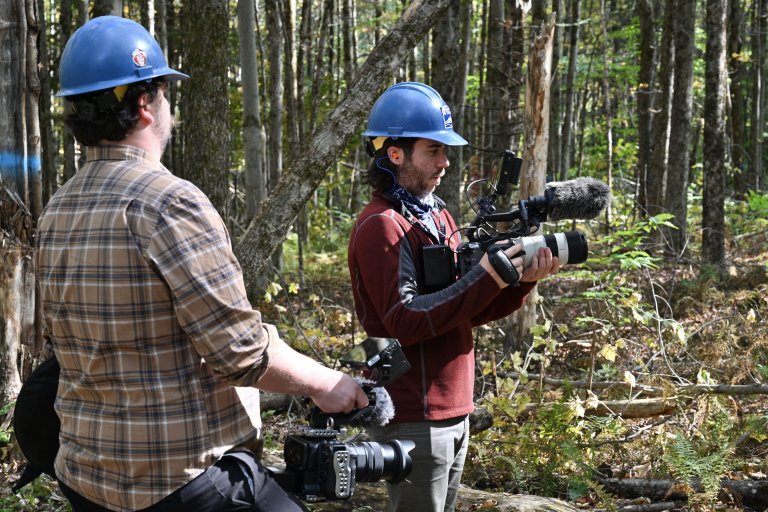
Beltramo told him about the personal project he was working on, and he was “a consistent, encouraging voice” throughout the last year and a half of the film’s production. Beltramo put together a list of what he would want to accomplish if he could go back to Vermont one more time to shoot. “That became our roadmap, and we went back to Vermont for two weeks and got everything we needed.”
The one constant throughout the process was the commitment to screen the film for the first time at the Vermont Climbing Festival. The only problem was it was already August, and the festival was in September. “I had three-and-a-half weeks to pull it all together, but I did,” he says. “It felt like the right thing to do. We came back and played it for the community, and it’s been well received so far. Now we’re submitting it to film festivals to see where it can go. I think the message of community can extend and apply beyond just climbing.”
Beltramo’s journey illustrates how the Norwich spirit uniquely shapes each community member’s life. The path that led him to the University somehow made its way around the country and back to Vermont, where he was able to use his passion for film to tell the story of a group of local climbers — even if it took a little longer than expected.
Read More
What Lasts: Stories from Norwich Homecoming
By Corrina Snow
At Norwich University’s 2026 Homecoming, alumni returned to Northfield to reconnect, share memories, and celebrate relationships that extend long after graduation.
6 min read
Athletics: Zacher selected for NCAA Division III Athletic Communicators Emerging Elite Program
By Norwich Athletic Communications
This link takes the reader to an external article.
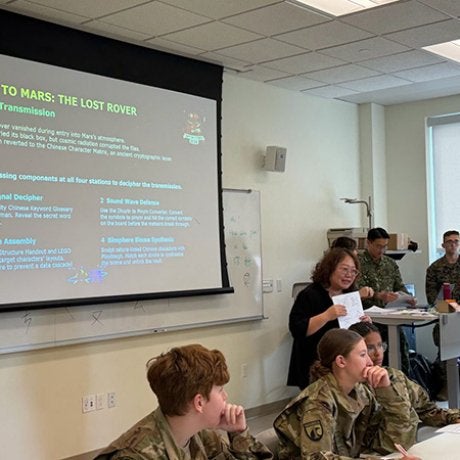
Mars Missions Bring Cybersecurity to Life at Day of Cyber
By Dr. W. Travis Morris
Nearly 300 students and educators explored cybersecurity, robotics and teamwork through hands-on adventures.
3 min read