
Strategic Leadership Under Pressure: A Look Inside Norwich’s International Graduate Seminar
Norwich University Online launches a Global Strategic Leadership pilot with Helmut Schmidt University and brings students to Germany to practice strategy under pressure.
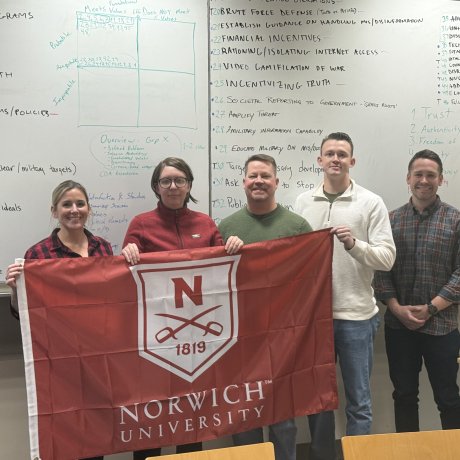
Strategic leadership is rarely developed in controlled environments. Today’s leaders are expected to navigate uncertainty, manage risk across borders, and make decisions with political, economic, and ethical consequences, often with incomplete information and limited time. Recognizing this reality, Norwich University Online launched a Global Strategic Leadership pilot designed to place graduate students in realistic, high-stakes learning environments where strategy is practiced, not just discussed.
Delivered in partnership with Helmut Schmidt University in Hamburg, Germany, the pilot combined ten weeks of virtual instruction with a one-week international, in-residence seminar. The experience challenged students to apply strategic frameworks, collaborate across cultures, and communicate clearly under pressure.
What emerged was not a traditional academic exercise, but a rigorous, immersive seminar that tested how students think, lead, and perform when complexity is unavoidable.
A Different Kind of Graduate Experience
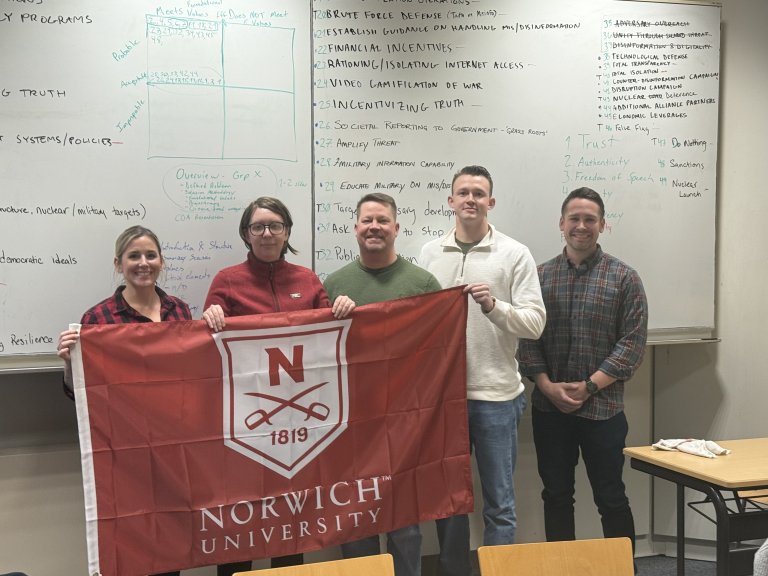
The Global Strategic Leadership pilot was intentionally designed to function as a capstone-style seminar rather than a conventional online course with a travel component. Students examined transnational security challenges, with a particular focus on disinformation, systems thinking, ethical decision-making, and executive communication.
Learning unfolded in two distinct phases. During the virtual portion, students built a shared intellectual foundation while working in multinational teams. That groundwork culminated in an in-residence seminar in Hamburg, where students applied those concepts through simulations, group problem-solving, and executive-level briefings.
Because students arrived prepared, the in-person sessions moved quickly into advanced analysis rather than introductory discussion. Classroom time was devoted to testing ideas, refining strategies, and responding to evolving scenarios in real time.
Learning Under Pressure
One of the defining moments of the seminar came during a surprise crisis scenario introduced near the conclusion of the in-residence week. Students were presented with a simulated transnational economic and cyber crisis and given limited time to assess the situation, organize themselves, and brief senior leaders.
There were no assigned roles and no prescriptive instructions. Students had to self-organize, delegate responsibilities, synthesize complex information, and deliver coherent strategic recommendations under tight time constraints.
For many participants, this was the point where theory became tangible. Frameworks discussed during the virtual portion were no longer abstract. They became tools used in real time, under pressure, with visible consequences.
Carl Petermann, a Master of Science in Leadership student, reflected on how the experience reshaped his thinking:
“The in-person problem-solving sessions forced me to confront how narrow my thinking had become. This course pushed me to move beyond comfortable frameworks and practice real strategic thinking, where integrity means aligning actions with values and accountability includes second- and third-order effects.”
The Power of a Cross-Cultural Cohort
The pilot's core strength was its intentionally diverse cohort. Graduate students from the United States, Germany, and France brought perspectives shaped by different national, professional, and academic contexts.
These differences were not incidental. They were central to the learning design.
Kyle Dunn, a Norwich graduate student, described how the international component shaped his understanding of leadership:
“Working with our international peers was a unique opportunity to see firsthand how the differences in our cultures shaped our idea selection. It helped me understand that learning a peer's culture can support a unified decision that not only makes sense but works best with both partners.”
The in-person experience made cultural nuance visible. Students saw how values, assumptions, and institutional contexts influence decision-making. They also experienced how deliberate listening and cultural awareness can produce stronger, more unified strategic outcomes.
Donnie Gray, a Master of Science in Leadership student, emphasized how the experience broadened his perspective:
“The in-person seminar fundamentally changed how I understand leadership in a global context. Engaging with international students deepened my empathy and broadened my perspective on democracy, strategy, and the real human impact of global decisions.”
These interactions directly supported learning outcomes related to emotional intelligence, cross-cultural communication, and multinational teamwork, competencies that are increasingly essential for leaders operating in complex global environments.
As Dr. Diane Zorri, academic director of strategic studies at Norwich University, observed:
“Watching students from two nations build real solutions side by side made it clear this was a truly transformative experience. Norwich’s commitment to expanding hybrid, in-residence opportunities is exactly how global leaders should be developed.”
High Expectations, Real Growth
The Global Strategic Leadership pilot was demanding by design.
The workload was intensive, particularly during the early weeks and the in-residence seminar. Students were expected to engage deeply, contribute consistently, and adapt to unfamiliar academic and cultural norms. Differences between institutional systems and academic calendars added additional complexity.
Those challenges were not ignored. They were documented, evaluated, and used to inform improvements for future offerings. Importantly, they did not diminish learning outcomes.
Jessica Rolland, a Master of Science in Management student, reflected on the personal growth that resulted:
“This experience tested my core values and forced me to apply them in real time. It reinforced that authentic leadership requires self-awareness, emotional intelligence, and the courage to align decisions with values.”
The rigor of the experience was inseparable from its value. Students were required not only to understand strategy but to live it through collaboration, uncertainty, and disciplined reflection.
Proof of Concept and What Comes Next
Despite operating within a compressed recruitment and planning window, interest in the pilot exceeded available seats. Students from multiple graduate programs participated, and additional students expressed interest but were unable to attend due to timing or logistical constraints.
The pilot validated proof of concept for an international, hybrid seminar model within Norwich University Online. With targeted improvements to systems integration, workload pacing, and early communication, similar offerings are well-positioned for expansion across additional graduate programs, including leadership, strategic studies, diplomacy, business, cybersecurity, and related fields.
For future students, this model offers something distinct.
It is not designed for everyone. It is designed for those who want to test themselves, who are willing to engage deeply, and who understand that leadership is learned through experience, not observation.
For students seeking more than a traditional online course, Norwich University Online’s hybrid, in-residence seminars offer the opportunity to practice strategic leadership before it is required of them professionally.
Read More
2026 Military Writers’ Symposium: How Cinema Shapes Our Perception of War
By Zack Bennett
Two days of programming on media and war features student research, expert panels, and a look at Darby’s Rangers.
3 min read

School of Architecture + Art to host John Cays
By NU Marketing & Communications Office
A subject-matter expert brings his expertise to Chaplin Hall on the Northfield campus.
2 min read
Mars Missions Bring Cybersecurity to Life at Day of Cyber
By Dr. W. Travis Morris
Nearly 300 students and educators explored cybersecurity, robotics and teamwork through hands-on adventures.
3 min read