- Norwich Blogs
- Blogs
- A Nail in the Coffin? Belarus Changes Its Course
A Nail in the Coffin? Belarus Changes Its Course
By Dr. Lasha Tchantouridze and Dr. Stefan Brooks
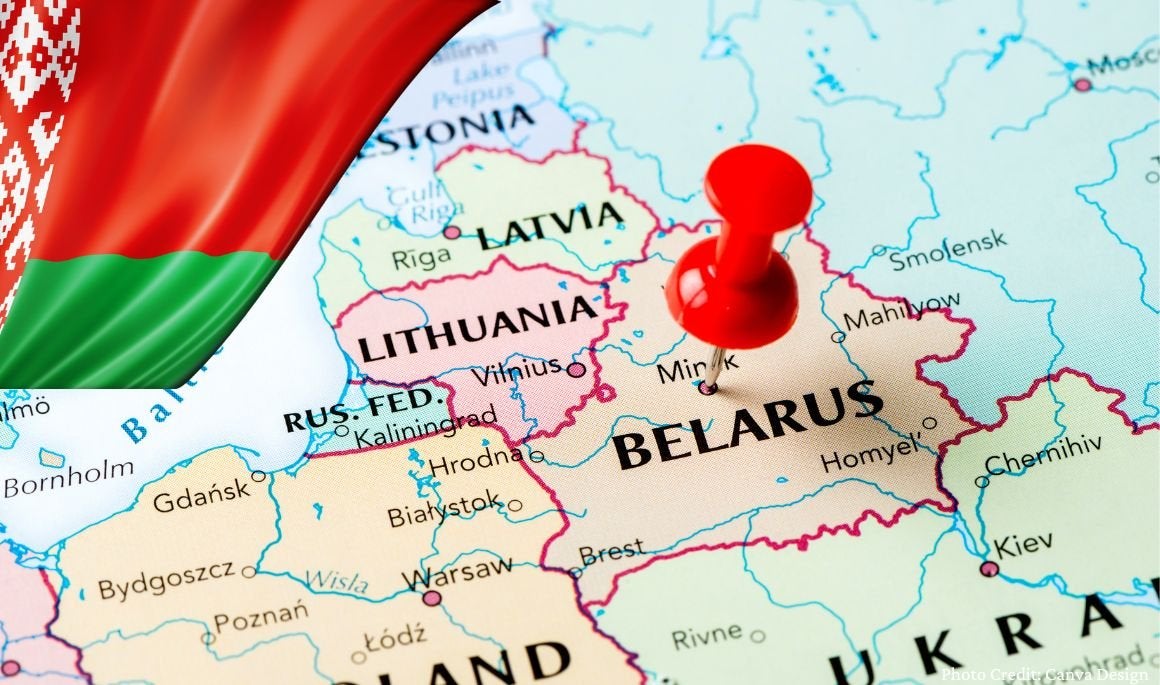
The article argues that Belarus is undergoing a significant strategic shift, reassessing its longstanding alignment and policies in response to changing regional security and geopolitical pressures, particularly those stemming from Russia’s influence and broader European dynamics. It examines how this change could affect Belarus’s future role in Eastern Europe, suggesting that the country may be moving in a direction that could alter regional power relationships and security calculations
Disclaimer: These opinion pieces represent the authors’ personal views and do not necessarily reflect the official policies or positions of Norwich University or PAWC.
No other recent development has signaled the weakening of Russia’s position in its war against Ukraine more than recent reversals made by its closest ally, Belarus. In his June 2026 public statements, Alexander Lukashenko, Belarus’s authoritarian president, acknowledged the new realities of the Russo-Ukrainian war and its potentially devastating consequences for his country. Lukashenko conceded that the military and industrial infrastructure of Belarus was absolutely vulnerable and defenseless if the armed forces of Ukraine were to target his country the same way they attacked Russia. In his June 15, 2026, interview with the Al Arabiya television channel, Lukashenko called it “absolutely unacceptable” for Belarus to be dragged into the Russo-Ukrainian war.[i] To emphasize the dramatic nature of his country’s vulnerability, Lukashenko used a Russian idiomatic expression: Belarus is exposed to the armed forces of Ukraine as if it were “on the palm of their hand.”
Lukashenko is one of the longest-serving heads of state in the world. He has held the presidency of Belarus since 1994, when he won the country's first presidential election on an anti-corruption platform. Since then, he has manipulated constitutional processes and used the state apparatus to keep the opposition weak, thereby remaining in power. A polarizing figure, he has kept Belarus closely aligned with Russia, but at the same time, he has pointedly refused to follow every dictate from Moscow. For example, he has refused to obey Moscow’s demands to recognize the sovereignty of Russia-occupied Georgian provinces of Abkhazia and South Ossetia. He repeatedly describes his vision of Russia-Belarus relations as one homeland-two states: "we have two states, but one homeland."
The words and actions of the Belarusian leadership since mid-June 2026 constitute a major strategic reversal for Russia in its attempts to defeat Ukraine. Lukashenko’s current rhetoric is dramatically different from his words in late February 2022. Back then, he echoed widely circulating sentiments that Kyiv would fall in three days and that soon there would be no one left standing to fight for Ukraine. Lukashenko even added his own flourish to justify the Russian invasion, in which significant components of the Russian land and aerial attacks were launched from Belarusian soil. He claimed that the joint Russo-Belarusian attack on Ukraine was a preemptive war, alleging that Kyiv was about to attack them both. Lukashenko’s theatrical presentation, aimed at making the point, even became a social media meme in the region.
At the same time, Lukashenko remained careful not to cross the ultimate line and commit Belarusian troops to actual combat, even though for most of 2022 and 2023 the Belarusian forces feigned preparations for a land invasion. In late 2021 and early 2022, Lukashenko allowed Belarusian territory to be used as a launchpad for the invasion. Russian forces that had deployed to Belarus before the invasion remained there and crossed into northern Ukraine on Feb. 24, 2022, including for the offensive toward Kyiv. Russia also launched missiles and air operations from Belarusian territory. Soon after the invasion, the Belarusian ground forces commenced maneuvers and "exercises" that lasted for more than a year. By doing this, they distracted the Ukrainian leadership, forcing them to keep significant units of Ukraine’s armed forces at the Belarus border in anticipation of Lukashenko’s forces joining the fight.
Although the Belarusian forces have never joined the war in Ukraine, Lukashenko continued to provide strong political and logistical support to Russia while avoiding direct participation by Belarusian troops. That started changing in June 2026. Until then, Lukashenko’s public position on the war was consistently pro-Russian, emphasizing continued strategic support for Russia. Since June, however, he has been urging de-escalation and a peaceful solution, emphasizing that the Russo-Ukrainian war has no military solution. In a July speech to his military officers, he promised, "Nobody is going to send you into this bloodbath," and once again mentioned his government’s support for a peaceful resolution.
After his June 16, 2026, Al Arabiya interview, where he called it "absolutely unacceptable" for Belarus to be dragged into the Russo-Ukrainian war, Ukrainian President Volodymyr Zelenskyy issued a one-week ultimatum to Belarus, demanding on June 19, 2026, that Belarus remove signal relay stations, communications, and targeting equipment from its territory that have been used for Russian strikes on Ukraine.[ii] Zelenskyy warned that if Minsk did not remove this equipment from its territory, Ukraine would do so by force. The relays located in the Brest and Gomel regions were used to guide Russia’s Geran (a variation of Iran’s Shahed) drones. Remarkably, Belarus complied within the week: by June 22, the equipment was powered down, with no public reaction from Putin.[iii]
Lukashenko’s reevaluation of his position toward the war in Ukraine marks a major sea change in the war, which, because of its stalemate, may reflect his concern that continued support for Russia provides no strategic advantage for Belarus. Indeed, the stalemated nature of the war has revealed the weakness and incompetence of Putin’s Russia, and Lukashenko may have concluded that, because Putin has little to no leverage over him anymore, now is the time for Belarus to distance itself from having aligned with Russia in a war with no apparent victory for Moscow.
In addition to Russia losing access to the communications and targeting equipment in Belarus, Russia also lost access to Belarus’s military equipment and personnel. Even though Lukashenko had refused to send Belarusian troops into combat, they remained a hypothetical reserve for Russia until this summer. Furthermore, Lukashenko’s attempts to adopt a neutral stance supporting a peaceful resolution to the war deprive Moscow of any hope that it could leverage or secure desperately needed assistance from Belarus to try to bring the stalemate in Ukraine to a successful resolution. Lukashenko’s dramatic acknowledgment in June that Belarus was defenseless and vulnerable if Ukraine decided to attack exposed the fact that Russia was unwilling, or rather unable, to defend its closest ally. In so doing, he clearly signaled that Russia was an unreliable ally and possibly sought to portray Belarus as having made a mistake by supporting Russia. All the more remarkable is Putin’s silence on Lukashenko’s actions.
Lukashenko’s about-face on Ukraine stands in sharp contrast to his 2023 excitement regarding a nuclear-sharing agreement with Russia. According to that agreement, Belarus acquired nuclear-capable 9K720 Iskander-M ballistic missiles and adapted its Su-25 ground-attack aircraft. These nuclear weapons are deployed to Belarus under a dual-key arrangement: The weapons are housed on Belarusian soil, but Russia maintains exclusive operational command and physical control over the warheads, and Belarus owns and controls their delivery equipment, missiles, and aircraft. At that time, Lukashenko’s excitement stemmed from his belief that nuclear weapons would make Belarus’s defense and security watertight. Now he concedes the fact that nuclear weapons have no utility in defending Belarus from potential conventional drone attacks from Ukraine.
Most importantly, Lukashenko’s turnaround confirms the widely circulating belief that Russia’s campaign to forcibly subjugate Ukraine is doomed to fail. No other non-Russian leader knows Moscow and its inner workings better than Lukashenko. The fact that he is risking the wrath of his "older brother," Putin, strongly supports the assertions of observers who have noted the declining fortunes of the Russian armed forces on the battlefield and the near exhaustion of their human and material reserves.
Lasha Tchantouridze, Ph.D., professor, the Joint and Combined Warfighting School, the Joint Forces Staff College, the National Defense University, Norfolk, Virginia.
Stefan Brooks, Ph.D., associate professor, the Joint and Combined Warfighting School, the Joint Forces Staff College, the National Defense University, Norfolk, Virginia.
[i] TV Channel Belarus 24, "How to End the War in Ukraine? Full Lukashenko Interview with Al Arabiya." The full text of the interview in Russian is available on President Lukashenko’s website: "Полная версия интервью Александра Лукашенко телеканалу "Аль-Арабия"," President of the Republic of Belarus.