
- Norwich Blogs
- Blogs
- Latvia at the Edge: The Looming Risk of a Russian False-Flag Operation in the Baltics
Latvia at the Edge: The Looming Risk of a Russian False-Flag Operation in the Baltics
By Dr. James M. Deitch
The article argues that Latvia is facing an increasingly dangerous pattern of Russian hybrid provocations, including drone incursions, airspace violations, cyber activities, and disinformation campaigns, that may be laying the groundwork for a potential false-flag incident designed to test NATO cohesion. It highlights how Latvia has responded by strengthening its military capabilities, expanding conscription and territorial defense forces, enhancing counter-drone and civil defense measures, and deepening cooperation with NATO and Nordic allies. The author concludes that while Latvia has taken significant steps to prepare for escalation, NATO must remain vigilant and ready to respond rapidly to ambiguous threats, as future aggression in the Baltics may begin through hybrid tactics rather than conventional military attacks.
Disclaimer: These opinion pieces represent the authors’ personal views and do not necessarily reflect the official policies or positions of Norwich University or PAWC.
Latvia stands today in a narrowing corridor of strategic warning, where history’s long shadow has begun to sharpen into something more immediate and more volatile. The Baltic region has always lived with the memory of occupation and the proximity of Russian power, but the last year has transformed that memory into a pattern of concrete provocations. Drone incursions, airspace violations, and a steady drumbeat of accusatory rhetoric from Moscow have created an environment that increasingly resembles the early stages of a manufactured crisis. The question is no longer whether Russia is pressuring NATO’s northeastern flank. That is already established. The question is whether Moscow is preparing the informational and operational groundwork for a false-flag event designed to fracture allied cohesion and justify further escalation.
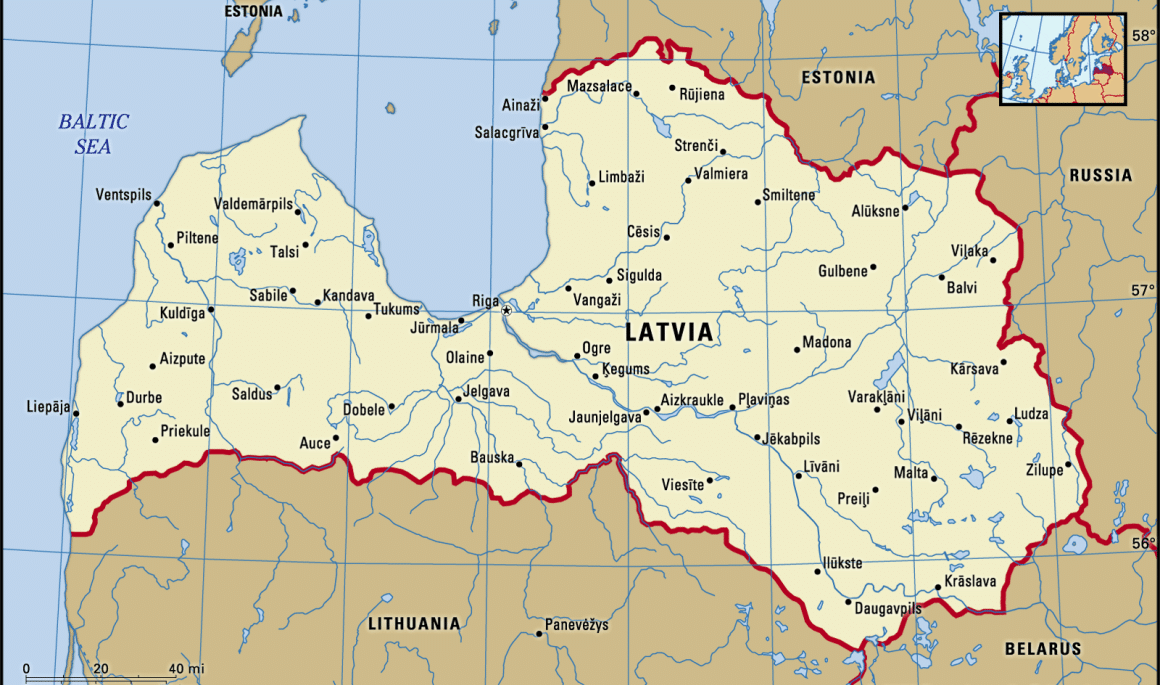
The events of early May marked a turning point. Multiple drones originating from Russia entered Latvian airspace, with one crashing into an oil storage facility and another believed to have fallen in Rēzekne municipality. Latvian authorities chose not to intercept the drones, citing the risk of debris falling on civilians or critical infrastructure.[1] These incidents did not occur in isolation. They followed a series of Russian airspace violations across the Baltics and Poland, including NATO jets shooting down Russian drones and Estonia reporting a twelve-minute incursion by three Russian MiG-31s.[2] Latvia’s foreign minister has warned that Russia is deliberately testing NATO defenses with these incursions.[3] The tempo, geography, and ambiguity of these probes align closely with Russia’s long-standing doctrine of pressure below the threshold of open conflict, a doctrine that has historically preceded false-flag operations in Georgia, Crimea, and the Donbas.
False-flag operations require narrative preparation, operational ambiguity, and plausible deniability. Russia has been cultivating all three. In its narrative preparation, Russian state media and official channels have increasingly framed the Baltics, and Latvia in particular, as hostile, Russophobic, and complicit in Ukrainian attacks. Moscow has accused Latvia of facilitating Ukrainian drone operations, claims Riga has dismissed as pure fiction.[4] These accusations mirror the rhetorical groundwork Russia laid before its interventions in Crimea and eastern Ukraine, where allegations of persecution or covert aggression were used to justify “protective” action.
Operational ambiguity has become a central feature of Russia’s behavior. Drone incursions are ideal tools for this purpose. They can be disavowed, misattributed, or framed as Ukrainian provocations. The May drones that entered Latvia fit this pattern precisely. Their origin remains under investigation, and Russia has already denied responsibility.[5] This ambiguity creates space for Moscow to claim victimhood or to threaten retaliation if a future incident is engineered to cause casualties or damage. The ambiguity is not a flaw in the operation; it is the point.
Plausible deniability completes the triad. Russia’s Ministry of Defense has repeatedly described its flights near Baltic airspace as routine and compliant with international rules, even when aircraft lacked transponders, flight plans, or radio communication.[6] This is classic Russian signaling: normalize the abnormal, deny the obvious, and maintain a veneer of legality while probing for weakness. Taken together, these elements form the scaffolding of a false-flag environment, one that can be activated quickly if Moscow perceives a strategic advantage.
The strategic environment of escalation
The Baltic region has entered a period of heightened instability, shaped by Russia’s shifting strategic calculus and the pressures of its ongoing war in Ukraine. As Russia absorbs battlefield losses and confronts the long-term economic and political costs of its invasion, it has increasingly turned to hybrid tactics to regain the initiative. The Baltics offer a tempting arena for such activity. They are NATO territory, but small, geographically exposed, and symbolically important. A crisis here tests the alliance’s cohesion without requiring Russia to commit large conventional forces.
Latvia’s geography amplifies this vulnerability. It shares a long border with Russia and sits adjacent to the Suwałki Gap, the narrow corridor linking the Baltic states to the rest of NATO. Russian military planners have long viewed this region as a potential pressure point. In recent months, Russian forces have increased their activity near the border, conducting exercises that simulate rapid incursions and electronic warfare operations. Reporting from the Estonian Public Broadcasting (ERR) has noted a rise in Russian jamming activity near the border, affecting GPS signals in southeastern Estonia and northern Latvia.[7] These activities, while not unprecedented, have taken on new significance in the context of drone incursions and escalating rhetoric.
Russia’s information operations have intensified in parallel. State media outlets have amplified narratives portraying Latvia as a failed state, a persecutor of Russian speakers, and a staging ground for Ukrainian attacks. Analysts at the Atlantic Council have noted that Russia’s messaging toward the Baltics has grown more aggressive since late 2024, with a particular focus on portraying NATO’s presence as provocative and illegitimate.[8] These narratives are not new, but their frequency and intensity have increased markedly. They serve to condition domestic audiences for potential escalation and to create a pretext for action. In this sense, the information environment is not merely background noise; it is an operational domain in its own right.
Latvia has responded with clarity and resolve. Its leaders have warned openly of the risks posed by Russian provocations and have called on NATO to strengthen its presence in the region. President Edgars Rinkēvičs has emphasized that the Baltic states are the frontline of European security and that any attack on Latvia would trigger a collective response.[9] This messaging is aimed not only at deterring Russia but also at reinforcing allied unity. Latvia understands that deterrence is as much about perception as capability.
The Baltic Times has reported that Latvia has increased its diplomatic outreach to Nordic partners, particularly Finland and Sweden, whose NATO accession has transformed the strategic map of northern Europe.[10] The emerging Baltic-Nordic security architecture is one of the most cohesive in Europe, and Latvia is at its center. This regional alignment strengthens deterrence but also increases the stakes of any Russian provocation.
Latvia’s military transformation and national readiness
Latvia’s defense reforms since 2022 have been sweeping and consequential. The reintroduction of mandatory national service marked a significant shift in national defense policy, reflecting a recognition that the security environment had fundamentally changed. Reporting from LSM, Latvia’s public broadcaster, has highlighted the rapid expansion of Latvia’s National Guard and the integration of new conscripts into territorial defense units.[11] The Latvian Armed Forces have expanded their territorial defense units, integrating volunteers and reservists into a cohesive national defense structure. This approach mirrors the Finnish model, emphasizing resilience, dispersion, and rapid mobilization in a crisis.
Latvia has also invested heavily in modernizing its equipment and infrastructure. It has acquired new air-defense systems, anti-armor weapons, and surveillance capabilities. These investments are designed to counter the specific threats posed by Russia’s hybrid tactics, including drones, electronic warfare, and sabotage. The development of counter-drone capabilities has been a particular priority, reflecting the lessons learned from Ukraine and the recent incursions into Latvian airspace. Analysts at ICDS Tallinn have noted that Latvia’s counter-drone procurement is among the most advanced in the region, with a focus on layered detection and jamming systems.[12]
The concept of a “drone wall” along NATO’s eastern border has gained traction in Latvia and its neighbors. This initiative envisions a layered system of sensors, jammers, and air defense assets designed to detect and neutralize drones before they can penetrate deeply into allied territory.[13] While still in its early stages, the drone wall represents a forward-leaning approach to countering hybrid threats. It acknowledges that the next crisis in the Baltics may begin not with tanks or aircraft, but with drones, sabotage, or manufactured incidents.
Latvia’s integration into NATO’s forward defense posture is equally significant. The Canadian-led NATO Enhanced Forward Presence battlegroup stationed in Latvia is set to expand into a brigade-level formation, reflecting the alliance’s commitment to deterrence. This multinational force includes troops from Spain, Italy, the Czech Republic, and other allies, providing a visible and credible deterrent to Russian aggression. Latvia has also advocated transforming NATO’s Baltic Air Policing mission into a Baltic Air Defense mission, with expanded rules of engagement and ground-based air defense assets.[14] This shift reflects the reality that policing is no longer sufficient when drones and aircraft are probing allied airspace with increasing frequency.
Latvia’s societal resilience is another critical component of its defense posture. The government has invested in civil defense programs, public communication campaigns, and resilience planning. These efforts aim to prepare the population for potential crises, including cyberattacks, disinformation campaigns, and disruptions to critical infrastructure. Reporting from Yle, Finland’s national public broadcasting company, has highlighted growing cooperation between Finnish and Latvian civil defense agencies, particularly in crisis communication and infrastructure protection.[15] Latvia’s experience with Russian hybrid tactics has made it acutely aware of the need for a whole-of-society approach to defense.
Russia’s escalating pattern of provocations
Russia’s behavior in the Baltic region over the past year has followed a clear and escalating pattern. The drone incursions of May were not isolated incidents but part of a broader campaign of hybrid pressure. Russian aircraft have repeatedly violated Baltic airspace, often flying without transponders or flight plans.[16] These violations are designed to test NATO’s response times and to create uncertainty about Russia’s intentions.
Russia has also engaged in cyberattacks and disinformation campaigns targeting Latvia and its neighbors. Analysts at the Center for European Policy Analysis have documented a surge in Russian cyber probing against Baltic energy infrastructure, particularly in Latvia and Lithuania, during the winter of 2024-2025.[17] These operations aim to undermine public trust in government institutions, sow discord within society, and weaken the alliance’s cohesion. The information domain has become a central battleground in Russia’s confrontation with the West, and Latvia has been a frequent target.
The accusations leveled by Russia against Latvia regarding Ukrainian drone activity are particularly concerning.[18] These claims, while baseless, serve to create a narrative that Latvia is engaged in hostile actions against Russia. This narrative could be used to justify retaliatory measures, including a false-flag operation. Russia has a long history of using manufactured incidents to justify military action, from the 1999 apartment bombings to the annexation of Crimea in 2014. The current pattern of behavior in the Baltics bears troubling similarities to these past episodes.
The risk of a false-flag event in Latvia is heightened by the ambiguity inherent in drone operations. Drones can be launched from a variety of platforms and can be easily misattributed. A drone that crashes into a civilian area could be framed as an attack by Ukraine or Latvia, providing a pretext for Russian retaliation. The ambiguity surrounding the origin of the drones that entered Latvian airspace in May underscores this risk.[19] Russia’s denial of responsibility, despite the evidence, is consistent with its past behavior and suggests that it may be preparing the ground for a more significant incident.
Baltic media outlet Delfi has reported that Russian border guards have increased their presence along the Latvian border, conducting what appear to be “inspection patrols” near crossing points.[20] While these activities are nominally routine, their timing and frequency raise concerns about potential staging or reconnaissance for a manufactured incident. Analysts at the Royal United Services Institute have warned that Russia may seek to create a crisis that blurs the line between hybrid and conventional aggression, exploiting ambiguity to delay or complicate NATO’s response.[21]
The road ahead: A region on the brink
Latvia stands at a dangerous moment defined by ambiguity, provocation, and the unmistakable signs of Russian pretext-building. The drone incursions of May were not an anomaly. They were a warning. Russia is probing, testing, and shaping the environment for a crisis that could erupt with little notice. The combination of drone incursions, airspace violations, accusatory rhetoric, and denials is not random. It is preparatory.
Yet Latvia is not without agency. It has demonstrated clarity, resolve, and a deep understanding of the threats it faces. Its investments in defense, resilience, and diplomacy have positioned it as one of NATO’s most forward-leaning members. Latvia’s leaders have spoken openly about the risks posed by Russia and have called on the alliance to strengthen its presence in the region. Their message is clear: the Baltics are the frontline of European security, and the frontline is being tested.
The challenge now is for NATO to match Latvia’s clarity. The alliance must recognize that the next crisis may begin not with a tank crossing a border, but with a drone falling from the sky. It must be prepared to respond swiftly and decisively to any provocation, including a false-flag event. The credibility of the alliance depends on its ability to deter aggression and to defend its members.
The Baltics have seen this pattern before. They know what comes next if warnings go unheeded. The question is whether the rest of the alliance is listening. Latvia has done everything within its power to prepare for the worst. It has strengthened its military, fortified its society, and deepened its integration with NATO. But it cannot face the threat alone. The hour is late, but not too late. The time for vigilance is now.
Dr. James M. Deitch was born in Philadelphia and raised in Bucks County, Pennsylvania. He attended high school in Heinavesi, Finland. He spent most of his Marine Corps career as an operations chief, serving deployments in Saudi Arabia, Kuwait, Iraq, and Norway, and aboard the USS Saratoga. Deitch holds a master’s degree in military history from Norwich University and a doctoral degree in intellectual history from Liberty University. He serves as a senior fellow at the Patton Center for Peace and War at Norwich University. His published doctoral dissertation focuses on the role of ethnic Germans in early American history. His published works can be found in “Total War Magazine,” “Concealed Carry Magazine,” “Real Clear Defense,” “Voices on Peace and War,” and the “Journal of the American Revolution.”
[1] Anna J. Davis, “Russia Rehearsing Tactics Along NATO’s Baltic Frontline,” Real Clear Defense, May 2025.
[2] “Latvia Urges NATO to Bolster Baltic Air Defence After Russian Incursions,” Reuters via US News, Sept. 27, 2025.
[3] “Latvia Warns Russia ‘Testing’ NATO Defenses with Drone and Aircraft Incursions,” Kyiv Post, Sept. 30, 2025.
[4] Reuters reporting on Russian accusations against Latvia regarding Ukrainian drone activity, 2025.
[5] Davis, “Russia Rehearsing Tactics Along NATO’s Baltic Frontline,” Real Clear Defense, May 2025.
[6] Ibid.
[7] ERR News, “GPS Interference Reported in Southeast Estonia,” January 2025.
[8] Atlantic Council, “Russia’s Information Strategy in the Baltics,” December 2024.
[9] “Latvia Urges NATO to Bolster Baltic Air Defence After Russian Incursions,” Reuters via US News, Sept. 27, 2025.
[10] Baltic Times, “Latvia Deepens Security Cooperation with Nordic Partners,” February 2025.
[11] LSM, “Latvia Expands National Guard and Conscription Program,” March 2025.
[12] ICDS Tallinn, “Counter-Drone Capabilities in the Baltic States,” April 2025.
[13] “Latvia Warns Russia ‘Testing’ NATO Defenses with Drone and Aircraft Incursions,” Kyiv Post, Sept. 30, 2025.
[14] “Latvia Urges NATO to Bolster Baltic Air Defence After Russian Incursions,” Reuters via US News, Sept. 27, 2025.
[15] Yle News, “Finland and Latvia Strengthen Civil Defense Cooperation,” November 2024.
[16] Davis, “Russia Rehearsing Tactics Along NATO’s Baltic Frontline,” Real Clear Defense, May 2025.
[17] CEPA, “Russian Cyber Probing of Baltic Energy Infrastructure,” January 2025.
[18] Reuters reporting on Russian accusations against Latvia regarding Ukrainian drone activity, 2025.
[19] Davis.
[20] Delfi Latvia, “Russian Border Patrol Activity Increases Near Latvian Frontier,” February 2025.
[21] RUSI, “Hybrid Escalation Risks in the Baltic Region,” December 2024.