
Leading in the Storm: Adaptive Leadership in an Era of Perpetual Volatility
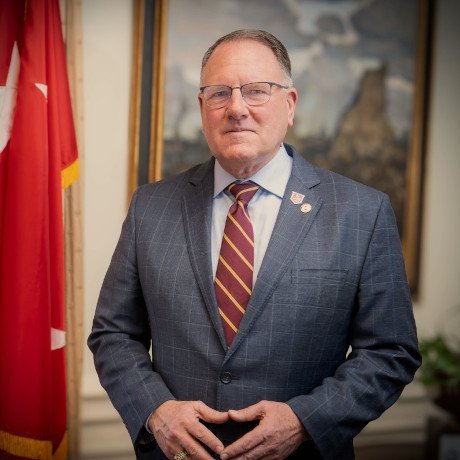
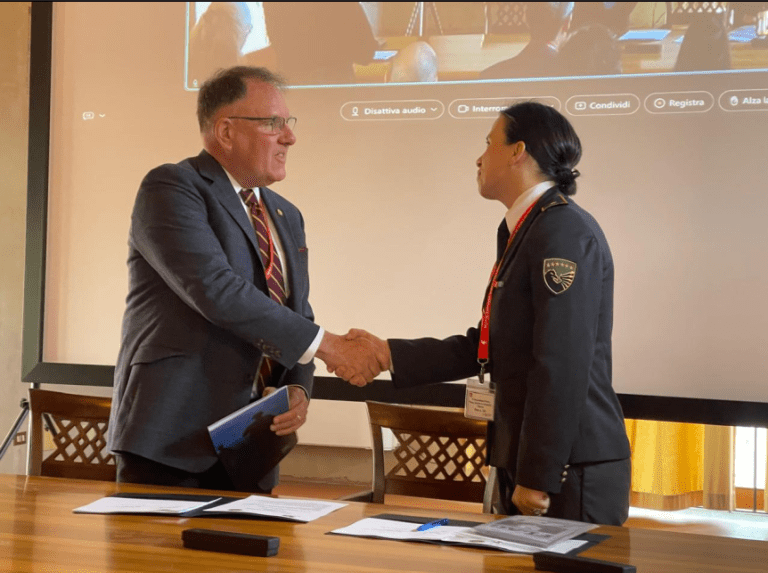
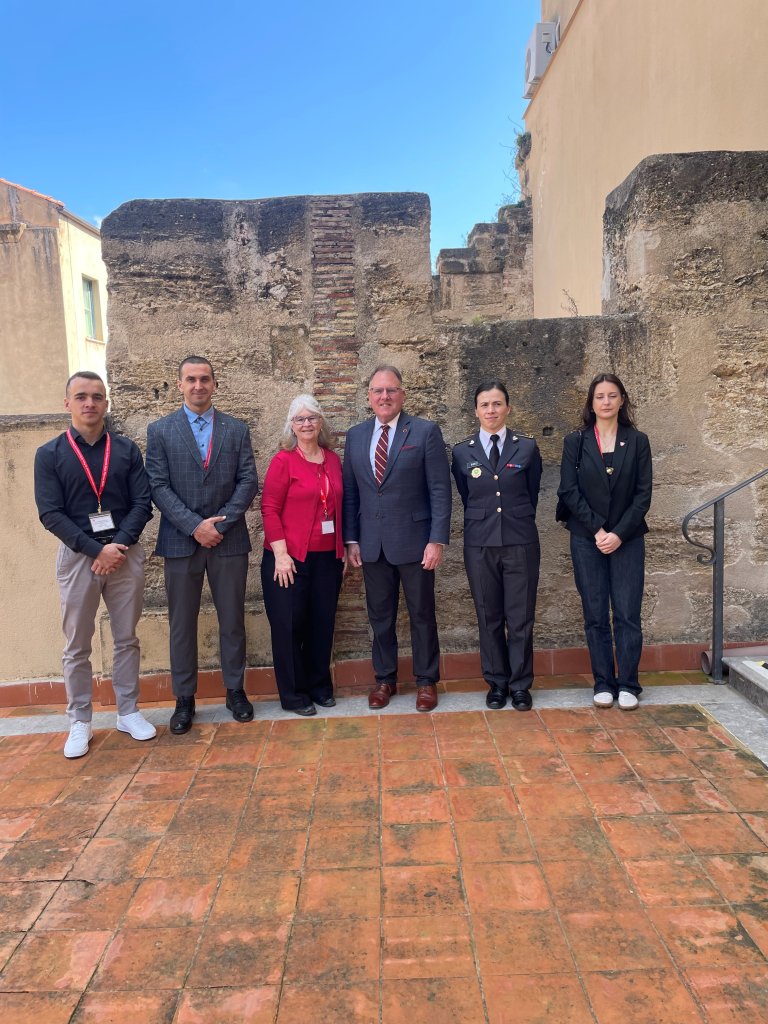
Norwich University's president travels to Italy alongside cadets to deliver remarks at the International Forum on Peace, Security and Prosperity.
Adaptation as a Leadership Duty
Distinguished officials, future military leaders, academic colleagues, and civic leaders —
What does it mean to lead when the rules of the game change faster than we can write them?
This is not a rhetorical question. It is the central challenge of our era. We gather here at a pivotal moment in history — one where traditional certainties have dissolved, where the character of conflict has fundamentally changed, and where the very definition of security is being rewritten in real-time.
Adaptation is no longer a skill we admire just in exceptional leaders. It is the baseline requirement for all leaders. And more than that — it is a duty. A duty to those we lead. A duty to the nations we serve. A duty to the fragile architecture of peace and security that previous generations built and that we are now called to defend.
Adaptation Under Pressure
Let me offer a personal vignette about what resilience and adaptation looks like in practice. For me, it is not theoretical. It is not abstract.
I’ve had the great privilege of serving with the First Marine Division over multiple tours in Iraq and Afghanistan. In 2003, the Division returned to Iraq after leading the U.S. Marine Corps’ attack to Baghdad the previous year. That attack alongside U.S. Army and coalition partners unfolded largely according to plans developed from our traditional military doctrine and against a conventional opponent.
However, in 2003, we found ourselves in Al Anbar Province, spread out in places like Fallujah, Ramadi, Al Qaim, and others, fighting a counter-insurgency effort against an enemy that used fundamentally different tactics and weapons. Fighters embedded in civilian populations and improvised explosive devices presented new and more deadly capabilities. Although we recognized the differences, we were slow to adapt. In the Division Combat Operations Center that slowness was reflected in a particularly poignant way. On the march to Baghdad, 1stMarDiv took relatively few casualties. We adopted the practice of posting pictures of fallen Marines at the back of the CoC and we continued that practice at the beginning of our operations in Al Anbar. At first we posted large, eight by ten photos not thinking that the big pictures and growing numbers casualties would soon fill the back wall. As the numbers continued to grow, to accommodate, we shifted to smaller photos, then other walls, and eventually onto a computer screen rotating the pictures of our fallen on a continuous loop. The physical and visual reality of the human impacts of this form of combat took a real mental toll on the Marines in the CoC. It also gave motivation to adapt to the realities of this new warfare. Throughout the Division and indeed all formations throughout Iraq, new tactics, techniques and procedures were adopted. We brushed off Vietnam era counter-insurgency doctrine and updated it for a modern fight. We shifted from soft-skinned vehicles to heavily armored MRAPs. We relearned the lessons of the need to work closely with indigenous forces and made growing the Iraq military and police a priority. In 2009, on my fourth and last tour in Iraq, I had the privilege of being the senior advisor to the 7th Iraqi Infantry Division, the first Iraqi Division to stand up under Iraqi control and assume responsibility for the counter-insurgency fight.
In the end, we adapted. But that wasn’t good enough. We entered the fight in Al Anbar assuming it would be like the fight to Baghdad and what we did then would be good enough for the next fight. The need to adapt was forced on us by our adversaries. In hindsight, we should have we had entered into this fight with adaptation front of mind in our planning.
Adaptation under pressure means making decisions with incomplete information, in compressed timeframes, with consequences that cascade across multiple domains simultaneously. It means accepting that the next crisis will not look like the last one — you must make adaptability one of your core competencies.
Multi-Domain Complexity
That requirement for adaptability already exists with the dizzying evolution of warfare. The officers and cadets in this room will not lead in a single domain. You will lead across an integrated battlespace that your predecessors could scarcely imagine:
In the cyber domain, where a 19-year-old adversary with a laptop can inflict strategic damage without ever donning a uniform.
In the information space, where narratives move at the speed of social media and truth is weaponized.
In the cognitive domain, where artificial intelligence and psychological operations target decision-making itself.
In hybrid conflict, where state and non-state actors blur the lines between war and peace, exploiting the gray zones our legal frameworks struggle to address.
And in civil-military crisis response, where pandemics, natural disasters, and societal fractures demand military capability married with humanitarian wisdom.
Here is what this means for you….. our future leaders:
Cross-domain literacy is no longer optional. You cannot be an expert only in your branch. You cannot master just one domain. The future demands leaders who can think across boundaries, who understand how actions in one domain cascade into others, who can orchestrate effects across the entire spectrum of competition and conflict.
This is why adaptation is not just about responding to change—it's about developing the cognitive skills to see connections others miss, to anticipate second and third-order effects, to lead in an environment where linear thinking is a liability.
Moral and Ethical Resilience
Adaptability also has a very human component. Resiliency is at the core of adaptability. But let me be specific about what kind of resilience matters most. In an era of autonomous weapons, algorithmic decision support, and ambiguous rules of engagement, the most critical form of resilience is moral and ethical resilience.
The future will present our forces with dilemmas that have no clear right answer. Artificial Intelligence will offer recommendations that are tactically sound but ethically questionable. Political pressure will conflict with professional military advice. The law will lag behind the reality of new weapons and new warfare.
In these moments, leaders need more than technical competence. You need moral clarity and moral courage. You need the resilience to do what is right when what is right is neither popular nor easy. You need the courage to speak truth to power.
This kind of resilience cannot be programmed. It must be cultivated through rigorous ethical education, through case studies of past failures and successes, through mentorship from leaders who have faced these dilemmas themselves.
The Cadet Advantage: Preparing the Next Generation
To the cadets and young officers here today — you are being forged in complexity. You are not learning about cyber warfare in theory — you are defending against it in your academies. You are not studying information operations from textbooks — you are navigating them daily in the information ecosystem you inhabit.
More importantly, you will train in environments that deliberately prepare you for volatility:
You train in advanced simulations that replicate multi-domain complexity with fidelity previous generations never experienced.
You operate in data-rich environments where you must make sense of overwhelming information — the exact skill required in modern command.
You study strategic analysis not as history but as a living discipline, examining ongoing conflicts and emerging threats.
You are exposed to information warfare scenarios that reflect the actual character of modern conflict.
But here's what you must do with this advantage: Don't just accumulate knowledge. You must really learn from it and incorporate it into who you are as a leader.
The advantage you have is not automatic. It must be activated through relentless intellectual curiosity, through humility about what you don't know, through seeking mentorship from those who have led in crisis, and through building the character that will sustain you when everything else fails.
International Resilience: Coalition as Strength
Now let me speak to why we are all here together, representatives of different nations, different services, different perspectives.
No nation, no matter how powerful, can secure itself alone in this era. The threats we face — cyber attacks, terrorism, climate disruption, pandemics, disinformation — these respect no borders. They exploit the seams between national jurisdictions. They move faster than any single nation can respond.
This means coalition is not a choice. It is a necessity. And forums like this one are not diplomatic niceties. They are strategic infrastructure.
The relationships being built in this room right now — between international officers and cadets, between military and civilian leaders, between practitioners and academics — these are not abstractions. They are the foundation of future operational capability.
When crisis strikes, when you need to coordinate a response across national boundaries, when you need to build consensus for difficult action—you will not start from zero. You will pick up the phone and call someone you met here. Someone you trained with. Someone whose judgment you trust because you forged that trust in peacetime.
These relationships become crisis contacts. They become coalition partners. They become strategic peers who can operate together with the interoperability that comes from shared understanding, not just shared equipment.
This is why professional military education must be international. Why our war colleges and staff colleges must bring together officers from allied and partner nations. I applaud you for starting this journey early. Continue to do it for the rest of your professional lives.
Building Adaptive Forces: The Leader’s Responsibility
Everything I've described demands one question: How do leaders actually build adaptive forces?
Let me be practical. You build adaptive forces by doing three things consistently:
First: Make Failure Productive
Create environments where it is safe to fail in training so your forces don't fail in combat. The organization that punishes every mistake breeds risk aversion. The organization that studies failure as a learning opportunity breeds innovation.
This means after-action reviews that focus on learning, not blame. It means exercises designed to push people to their breaking point so they discover their capacity before they need it. It means rewarding bold initiative even when it doesn't work perfectly.
Second: Decentralize Authority, Centralize Intent
In fast-moving, complex environments, centralized control breaks down. You cannot wait for permission from higher headquarters when the situation changes by the minute.
Adaptive forces operate on mission command: clear intent from leadership, decentralized execution from subordinates who are empowered to make decisions within that intent. This requires trust — which means you must develop subordinates capable of earning that trust.
Third: Invest in Continuous Learning
The half-life of military knowledge is shrinking. What you learned at your initial training will be partially obsolete before you reach senior command. This means professional military education cannot be an event—it must be a career-long commitment.
Adaptive leaders read voraciously. They seek diverse perspectives. They study adjacent fields. They maintain intellectual humility. They understand that every operation, every crisis, every failure of others contains lessons for those wise enough to extract them.
Personal Adaptability: The Leader’s Inner Discipline
But let me end this section with the hardest truth: You cannot build what you do not embody.
Personal adaptability and resilience begin with inner discipline. The discipline to maintain physical fitness when schedules are crushing. The discipline to protect time for reflection when operational tempo is relentless. The discipline to maintain relationships when career demands everything. The discipline to remain morally grounded when compromise is tempting.
This inner discipline is not about rigidity. It's about having core principles so strong that you can be flexible in everything else. It's about knowing yourself so well that external chaos doesn't create internal chaos.
Your forces will adapt to the degree that you demonstrate adaptation. They will remain resilient to the degree that they see resilience in you. Leadership is not a position. It is a daily performance of the values and capabilities you demand from others.
Closing: The Challenge Ahead
Let me close with a challenge — particularly to the cadets and young officers in this room, but truly to all of us.
The world you are inheriting is harder than the one your predecessors faced in many ways. The threats are more diffuse. The adversaries are more sophisticated. The stakes — when we talk about nuclear weapons, artificial intelligence, and climate disruption — are existential.
But you also have capabilities they never dreamed of. You have technology that amplifies human judgment. You have networks that enable global coordination. You have knowledge accumulated across human history at your fingertips.
The question is not whether you will face volatility and complexity. You will. The question is whether you will be ready.
My challenge to you is this:
Commit to becoming a learning leader — not someone who has learned, but someone who learns continuously, deliberately, relentlessly.
Build your resilience now, before crisis tests it — through rigorous training, ethical reflection, and the daily discipline of maintaining your physical, mental, and moral strength.
Invest in relationships across boundaries — national, organizational, and intellectual — because these relationships are the infrastructure of future security.
Embrace the discomfort of adaptation — seek out challenges that force you to think differently, operate differently, lead differently.
And finally: Remember that adaptation is not about abandoning principles. It is about being so committed to your core purpose — protecting human security, defending the vulnerable, preserving peace — that you will do whatever is necessary to fulfill that purpose in a changing world.
You are not called to be comfortable. You are called to be capable. Not to avoid difficulty. But to prevail through it.
The leaders who will secure the future are not those who resist change. They are those who harness it. Not those who fear volatility. But those who thrive in it. Not those who wish for simpler times. But those who rise to meet the complexity of this time.
That is your challenge. That is your opportunity. That is your duty.
Read More
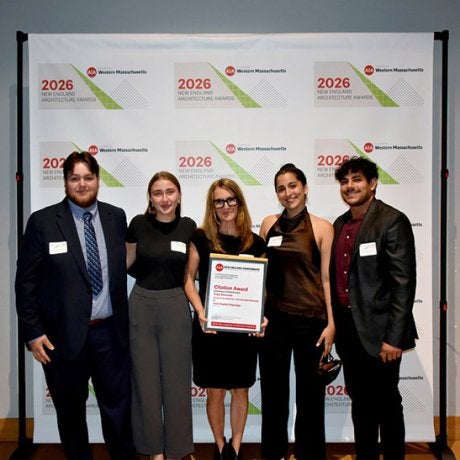
Norwich Design+Build Studio Wins Regional Architecture Award for Montpelier Playscape
By NU Marketing & Communications Office
American Institute of Architects New England honors student-built Little Rapids Playscape with a 2026 Citation Award.
2 min read

Norwich hosts hundreds of Vermont students for 'Day of Cyber'
By MyChamplainValley
This link takes the readers to an external article.
Norwich hosts hundreds of Vermont students for ‘Day of Cyber'
By WFFF Burlington
This link takes the reader to an external article.