- Norwich Blogs
- Blogs
- Roosevelt v. Roosevelt: Two Models for US Foreign Policy in the Western Hemisphere
Roosevelt v. Roosevelt: Two Models for US Foreign Policy in the Western Hemisphere
By Dr. Mary Fran T. Malone
The article contrasts two historical U.S. foreign-policy models in the Western Hemisphere — Theodore Roosevelt’s interventionist Roosevelt Corollary to the Monroe Doctrine, which justified direct military and economic control to enforce order and U.S. interests, and Franklin D. Roosevelt’s Good Neighbor Policy, which emphasized nonintervention, respect for sovereignty, and cooperative relations; it uses this comparison to suggest lessons for contemporary U.S. actions in Latin America.
Disclaimer: These opinion pieces represent the authors’ personal views and do not necessarily reflect the official policies or positions of Norwich University or PAWC.
If a nation shows that it knows how to act with reasonable efficiency and decency . . . if it keeps order and pays its obligations, it need fear no interference from the United States. Chronic wrong-doing, or an impotence which results in a general loosening of the ties of civilized society, may . . . ultimately require intervention by some civilized nation . . .Theodore Roosevelt, 1904[i]
In the field of world policy, I would dedicate this Nation to the policy of the good neighbor — the neighbor who resolutely respects himself and, because he does so, respects the rights of others — the neighbor who respects his obligations and respects the sanctity of his agreements in and with a world of neighbors. Franklin Delano Roosevelt, 1933[ii]
In the aftermath of the 2026 U.S. invasion of Venezuela, many observers have drawn comparisons between current U.S. foreign policy and that of earlier historical periods.
While initially President Trump justified U.S. military action as a means to curb drug trafficking and depose a dictator, he quickly added oil to this list. Lamenting state control over Venezuelan oil (which displaced American corporations two decades ago), President Trump pledged that the U.S. would “run” Venezuela, pave the way for the return of American investors, and deposit oil proceeds in Qatari bank accounts.[iii] To date, there is no plan for U.S. troops to occupy Venezuela, and former President Maduro’s regime has largely been left in place. On January 29, 2026, acting president Delcy Rodríguez signed a law to open the oil industry to private investors, just as the U.S. Treasury began easing sanctions on Venezuelan oil.[iv]
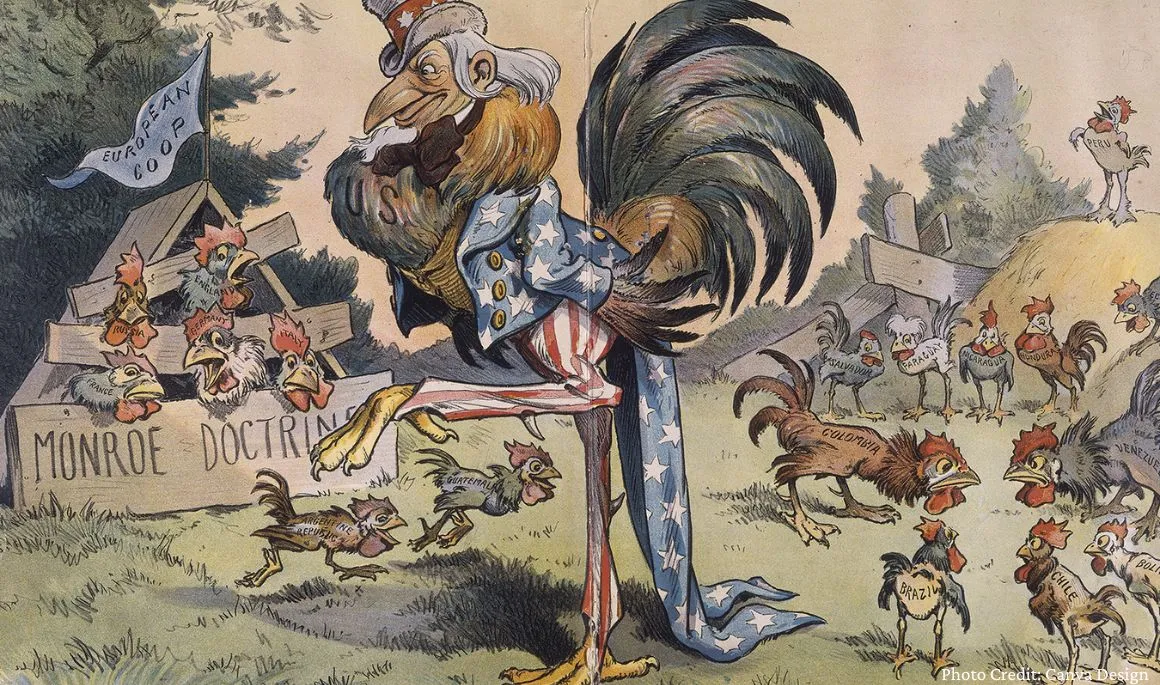
Such developments harken back to U.S. foreign policy at the turn of the 20th century under the Roosevelt Corollary to the Monroe Doctrine, which provided a broad and sweeping mandate for U.S. military intervention. While the exact nature of U.S. military intervention varied by country, there was a familiar playbook: the U.S. military invaded Latin American countries, controlled their customs houses, and installed leaders friendly to U.S. interests. The Roosevelt Corollary aimed to promote regional stability, deter European intervention, and advance U.S. economic interests. Yet, by the late 1920s, this foreign policy faced sharp criticism, and both military and business leaders questioned its benefits and sustainability. Why did this pattern of foreign policy fail to advance U.S. interests in the past? What can we learn from this historical evidence to inform U.S. foreign policy today?
The Roosevelt Corollary to the Monroe Doctrine
In the aftermath of the 1898 Spanish-American War, the U.S. extended its presence in the Caribbean by assuming control of former Spanish colonies and by strengthening its ability to deploy troops. The primary goal of U.S. foreign policy was to enforce the Monroe Doctrine and limit European expansion in the Western Hemisphere, but this goal was hindered by European military incursions to collect debts. Venezuela was the epicenter of these conflicts, as German, British, and Italian forces dispatched their navies to blockade the country and exert military pressure to force its leaders to pay their debts to European creditors. This challenged the Monroe Doctrine, and fears mounted that Germany in particular would use such military interventions as a pretext to seize territories and expand its presence in the U.S. sphere of influence.[v]
To deter such action, Roosevelt announced that the U.S. would be the de facto guarantor of European debts: it would use its military to invade countries in danger of default, and manage their customs houses to ensure that European creditors were repaid. U.S. assurances negated the need for European powers to deploy their forces. Once the U.S. seized Latin American customs houses, it was also well positioned to dictate favorable terms of trade for importing raw materials and exporting manufactured goods.
This style of military intervention, coupled with economic control, continued after Teddy Roosevelt. His successor, President William Taft, rechristened this policy as “Dollar Diplomacy” to emphasize its economic components over military ones, declaring that dollars would substitute for bullets. In practice, however, both dollars and bullets went hand in hand. Between 1898 and 1934, the U.S. launched over 30 military interventions in Latin America.[vi] The length and intensity of the U.S. occupation varied. In Honduras, the U.S. invaded sporadically and relied more upon domestic allies rather than its own troops to maintain control. In cases like Nicaragua, Panama, Cuba, the Dominican Republic, and Haiti, U.S. military occupation was more sustained, lasting anywhere from five to twenty years.
Why Didn’t the Roosevelt Corollary Work?
This style of intervention debuted to applause in U.S. foreign policy and economic circles, lauded for its potential to promote regional stability, deter European intervention, and advance U.S. economic interests. Over time, though, criticism of this style of intervention mounted, particularly as local resistance against U.S. forces became more sustained and violent. U.S. occupation of Nicaragua was a major issue in the 1928 U.S. presidential elections, for example, as ongoing domestic resistance to U.S. forces evolved into a full-scale uprising, led by guerrilla leader Augusto Sandino. Notably, business leaders who originally envisioned themselves as beneficiaries of U.S. policy became some of its most vocal critics. As one U.S. coffee planter in Nicaragua wrote to Secretary of State Henry Stimson:
Today we are hated and despised and in danger of massacre any time the Marines are withdrawn. This feeling has been created by employing the American Marines to hunt down and kill Nicaraguans in their own territory. This was a fatal mistake. The intervention of the U.S. government in the internal affairs of Nicaragua has proved a calamity for the American coffee planters doing business in this Republic.[vii]
Long term, the Roosevelt Corollary backfired. Due to the costs of military intervention in terms of casualties and dollars, President Franklin Delano Roosevelt withdrew U.S. forces from Nicaragua and other Latin American countries, ushering in a new era of U.S. foreign policy, the Good Neighbor Policy.
The Good Neighbor Policy
In 1933, Secretary of State Hull announced that “the United States government is as much opposed as any other government to interference with the freedom, the sovereignty, or other internal affairs or processes of the governments of other nations . . . no government need fear any intervention on the part of the United States . . .”[viii] Notably, the U.S. would no longer use military force to protect the property rights of U.S. citizens abroad; rather, U.S. citizens and companies were under the jurisdiction of the sovereign laws of host countries, and their courts or international arbiters would resolve disputes.
Even during the 1938 Mexican nationalization of the oil industry, the U.S. abided by the Good Neighbor Policy and refused to send its military to protect U.S. property, instead delegating the dispute to a joint commission for arbitration.[ix] FDR declared that promoting trade was the most important component of his foreign policy. To advance U.S. economic interests, he established institutions like the Export-Import Bank and negotiated a series of bilateral trade agreements to reduce tariffs. Trade between the U.S. and Latin American countries rose sharply, providing the U.S. with financial benefits and later securing vital raw materials for the war effort. FDR and Hull thought stronger commercial ties would also yield geopolitical advantages and reduce conflict in the region. FDR credited his Good Neighbor Policy as the cornerstone of hemispheric solidarity during World War II.
What Can We Learn?
The Cold War eventually disrupted the Good Neighbor Policy, but we can learn from the Roosevelt cousins’ different foreign policies. While it may have seemed initially promising to rely upon U.S. military forces to promote geopolitical and economic interests, in the long term, such intervention ultimately provoked anti-American sentiment and insurrection, leading to costly U.S. military occupations. Business leaders themselves were among the first to question the sustainability of military intervention, noting that the backlash it inspired jeopardized their investments.
In contrast, FDR’s Good Neighbor Policy promoted international trade, benefiting U.S. investors and securing access to vital raw materials during World War II. Hemispheric solidarity reduced the Axis powers’ ability to gain traction in the hemisphere, thereby promoting U.S. security. These contrasts remind us to consider not just the short-term gains, but long-term sustainability and the impact of relying upon U.S. military intervention to achieve economic and geopolitical goals.
Mary Fran T. Malone (Ph.D., University of Pittsburgh) is a professor of political science and international affairs at the University of New Hampshire. Her research focuses on political attitudes and behaviors in Latin America, particularly citizen support for the rule of law, political institutions, and democratic governance. Professor Malone’s recent book, Making Police Reform Matter in Latin America, examines how democracies can build police forces that fight crime while also protecting the civil liberties and rights of the citizens they serve.
[i] Theodore Roosevelt, “The Roosevelt Corollary to the Monroe Doctrine,” as cited in Latin American and the United States: a Documentary History, second edition, eds. R. H. Holden and E. Zolov (Oxford University Press, 2011), 97. Original quote in 1904.
[ii] Franklin Delano Roosevelt, “The Good Neighbor Policy,” as cited in Latin American and the United States: a Documentary History, 133. Original quote in 1933.
[iii] Reuters, “Venezuelan Banks Will Get $300 Million of Oil Money to Sell on Exchange Market, Sources Say,” January 16, 2026.
[iv] PBS News, “Venezuela’s Acting President Signs Overhaul Easing State Control of Oil Industry into Law,” January 29, 2026. To reassure foreign investors, this legislation stipulated that disputes would be arbitrated in independent courts, rather than Venezuelan ones.
[v] Peter H. Smith, Talons of the Eagle: Latin America, the United States, and the World, fifth edition (Oxford University Press, 2021).
[vi] Smith, Talons of the Eagle: Latin America, the United States, and the World.
[vii] Smith, Talons of the Eagle: Latin America, the United States, and the World, 95.
[viii] As quoted in Smith, Talons of the Eagle: Latin America, the United States, and the World, 97.
[ix] Cordell Hull, “Just Compensation for the Good Neighbor,” as cited in Latin American and the United States: a Documentary History, 142. Original statement in 1938.