America’s Kurdish Pivot in the “New” Middle East
This article outlines how Kurdish participation in many of the conflicts in the Middle East has shaped the trajectory of America's Middle East policy.
Disclaimer: These opinion pieces represent the authors’ personal views and do not necessarily reflect the official policies or positions of Norwich University or PAWC.
When the European empires, alongside the United States, engineered the modern Middle East after World War I, they swept aside the Kurds, along with other ethno-religious communities deemed undeserving of statehood, writing them out of the region’s political architecture. Since then, and until very recently, the Kurds have mainly appeared as problems to be managed or security threats to be eliminated to maintain mandate regimes and successor nation-states within an ideologically divided world order. As European colonial empires and the Cold War security order collapsed and the war on terror reshaped American priorities in the region, the Kurds have steadily reemerged onto the Middle Eastern political scene. The political limbo that offered neither the autonomy of Soviet nationalities nor the sovereignty enjoyed by post-colonial states allows the Kurds to play roles that are contingent, evolving, and closely tied to the uncertain political trajectories of the region. The ongoing U.S.–Israeli war with Iran only heightens this dynamic, elevating the Kurds’ strategic importance even as the regional order forged in the aftermath of World War I appears increasingly fragile.
Yet they have become significant actors not only within and across the political boundaries that divide them, but also in shaping the trajectory of America’s Middle East policy. The Kurds’ aspirations for sovereignty, defined less by formal statehood than by the capacity to govern and defend their own communities within existing states, have repeatedly converged with American strategic and security interests in the region, compelling these unlikely partners to work together time and again. This relationship has been romanticized as a passionate love affair, defined by cycles of devotion, betrayal, separation, and reunion, intense enough to provoke jealousy among neighboring states and regional actors that have long competed to claim the Kurds as their own.
What does this unlikely partnership reveal about the changing political order of the Middle East? What appears in the Kurdish case as a political ambiguity or even anomaly reflects a broader regional pattern that now defines the Middle East. This is evident in the recurring tendency of politicians, think tank analysts, and academics to present the region as “new,” suggesting a widespread belief that it is undergoing fundamental transformation. Yet this reinvention is rarely viewed from the vantage point of the Kurds’ changing roles, despite their growing significance to the region’s future and to America’s expanding role within it. Once relegated to the margins of a fragmented Middle East, the Kurds now occupy an unprecedented strategic position.
America’s Unlikely Partners: The Kurds
The Kurds have emerged as critical actors in the fight against jihadist organizations such as ISIS and al-Qaeda. They are poised to play a fundamental role in reshaping Iran’s political landscape, much as Kurdish actors helped shape Iraq’s political order after the fall of Saddam Hussein. Some also see the Kurds as an indispensable force in containing the Islamist ambitions of the Turkish government, which Israeli authorities have increasingly described as a “new Iran” after Assad’s fall, an event that brought Syria under the control of a Turkey-backed Islamist leadership.[ii] All of this aligns closely with America’s regional priorities and broader geopolitical calculations, which center on the security of Israel and competition with Russia and China. Together, these factors make the Kurds essential actors in shaping America’s relations with the four countries that have major Kurdish populations, namely Turkey, Iran, Iraq, and Syria, and, by extension, its broader Middle East policy.
The growing significance of the Kurds is not the product of a single movement or a unified national project. It reflects instead how Kurdish actors have adapted to the collapse of old regimes and the uneven rise of new ones. In the process, Kurdish insurgencies, political experiments, and military alliances have become deeply entangled with the persistent ambitions and ambiguities of global and regional powers. From the Gulf War and the American invasion of Iraq to the fight against ISIS and the specter of regime change in Iran, every major challenge to the regional status quo has revealed the dynamism of Kurdish politics.
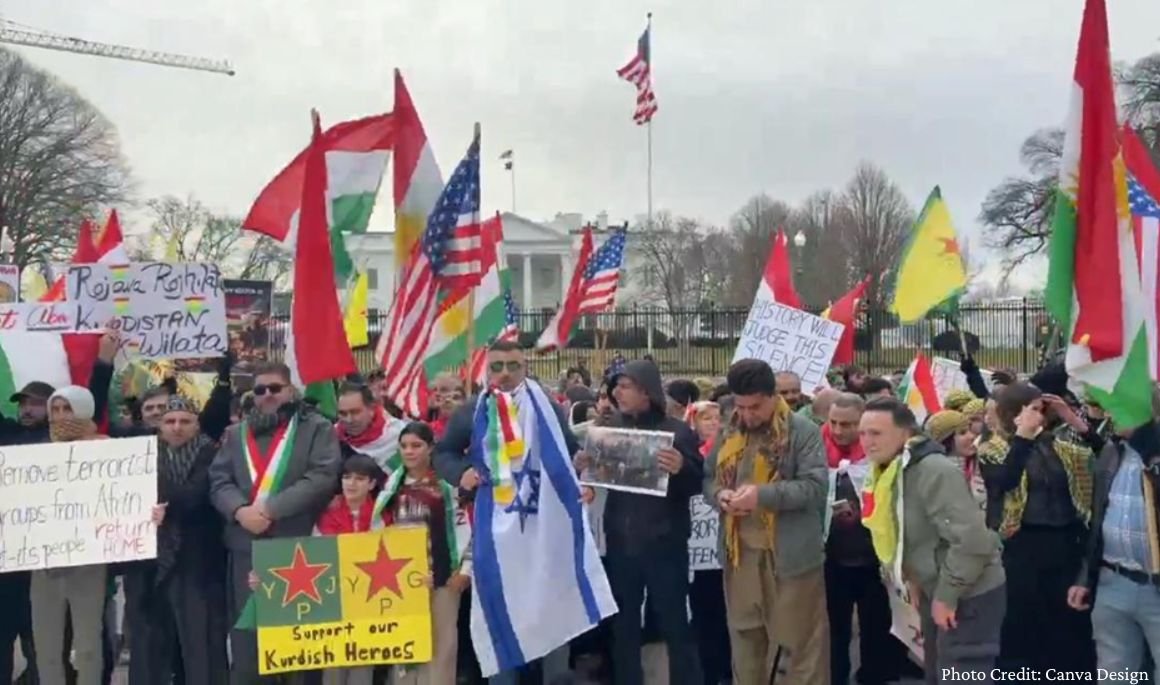
In Iraq, the Kurds have become the cornerstone of U.S. strategy and of any viable settlement of the country’s political and territorial future, underscored by the recent opening of the largest U.S. consulate in the world in Erbil, the capital of the autonomous Kurdistan Region of Iraq. In Syria, despite recent setbacks in their collaboration with the United States, the Kurds remain among the most vibrant actors in a war-torn country fractured along ethnic and sectarian lines. More importantly, the Rojava experience, the de facto autonomous administration led by the Kurds in northeastern Syria for more than a decade, has made the Kurds far more visible globally and contributed substantially to a growing sense of cross-border solidarity and patriotism among Kurds. Perhaps most consequentially, it has also generated increased sympathy toward the Kurds in the West, particularly in the United States and France, and in Israel, three influential states in Kurdish affairs, both among the public and within political circles.
In Iran, Kurdish mobilization has fused with nationwide demands for rights and representation, revealing how tightly Kurdish grievances now link domestic unrest to external pressure on the Islamic Republic. This was most evident in the nationwide protests triggered by the killing of Jina Mahsa Amini, a young Kurdish woman, by state forces in 2022, which rallied around the slogan ‘Women, Life, Freedom’ (Jin, Jiyan, Azadî), a phrase born in Kurdish resistance and carried onto the global stage by Kurdish women’s fight against ISIS in Syria. Home to the second-largest Kurdish population after Turkey and marked by a long history of political mobilization and intermittent experiences of autonomy, the Kurds in Iran are well-positioned to play a significant role in the country’s future.
Unlike Syria’s fragmented Kurdish regions along the Syrian–Turkish border, Iranian Kurdistan constitutes a contiguous territory along the Zagros Mountains, directly adjoining the autonomous Kurdish region of Iraq on the opposite side, which makes the prospect of cross-border Kurdish coordination and solidarity more feasible. This potential has been reinforced by the recent formation of the Alliance of Political Forces of Iranian Kurdistan, which brings together five major armed Kurdish opposition parties in a unified political and military front, positioning themselves for a post-Islamic Republic order. In the event of regime collapse, the Kurds are therefore likely to press for political autonomy in Iran and to emerge as the most credible allies of a U.S. role in reshaping the country’s future.
Talk of a U.S.-coordinated Kurdish ground operation inside Iran is already circulating.[iii] If the Iranian regime continues to resist external pressure, Washington may eventually conclude that regime change cannot occur without boots on the ground. In such a scenario, Kurdish forces could become a central partner, not only as instruments of American strategy but also because U.S. interests may once again align, at least temporarily, with long-standing Kurdish aspirations. That, after all, is often how politics works, a lesson the Kurds have learned the hard way.
Kurdish actors are cautiously calculating the possible outcomes. They understand that Iran is not a peripheral actor but a formidable regional power. Any confrontation would carry enormous risks. For that reason, it seems unlikely that the West could secure Kurdish participation through military assistance alone. Recent developments in Syria, where shifting alliances and uncertain Western commitments have repeatedly exposed Kurdish forces to sudden strategic reversals, are likely to make Kurdish leaders demand stronger and clearer guarantees. Moreover, Iran is a far bigger strategic challenge than many assume, and persuading Kurdish forces to enter such a conflict would likely require substantial political and strategic commitments than the provision of arms.
The Kurdish Question Reshaping the Middle East
Though the Kurdish factor in Iran is likely to dominate the next chapter in the Kurdish question, the most significant shift may be unfolding in Ankara, where these different pieces of the puzzle are being cautiously knit together. Long the demographic, political, and strategic center of gravity of the Kurdish question, the Turkish state increasingly recognizes that the Kurds will neither fade from view nor remain a problem to be managed within its borders. Turkey stands apart from every other state confronting a Kurdish question: it hosts roughly half of all Kurds, nearly a quarter of its eighty-five million population, sits at the core of NATO, and retains a deep imperial memory of shaping regional orders. Unlike most Middle Eastern states, modern Turkey was never formally colonized by a European power, which continues to outline its political imagination. Drawing insights from the collapse of the Ottoman Empire and from neighboring regimes that fractured under simultaneous internal and external pressure, Turkish leaders remain determined to prevent a divided or federalized Turkey from giving rise to a Kurdish polity on territory under their rule, a concern that has defined the republic’s national security priorities since its founding in 1923.
Despite its power, ambition, and experience, Turkey can no longer shape the Kurdish question unilaterally, compelling state elites to reimagine Turkish and Kurdish futures as intertwined rather than permanently opposed. Hence, likely with American encouragement, the Turkish state appears to be moving toward a framework that treats engagement with Kurdish actors, both within and beyond its borders, not as a concession but as a strategic recalibration. Regional geopolitics only heightens the stakes. In Iraq and Syria, the United States, alongside Israel, now exercises decisive influence over political and security outcomes. With the ongoing joint American-Israeli intervention in Iran, the two countries are also poised to shape the outcome of a post–Islamic Republic Iran should the current regime falter, an increasingly plausible scenario following the loss of a major ally in Syria with the toppling of Assad, Israeli and American strikes in the summer of 2025 that degraded Iran’s military command and nuclear program, and sustained unrest that has exposed deep economic and political vulnerabilities. Together, these developments have heightened Washington’s appetite for a more decisive push toward regime change. At the same time, Turkey, Iran’s historic rival and a state with deep ties to Iran’s large Azeri Turkish population, has begun strengthening these connections to counterbalance Kurdish influence and project its power into a potential post–Islamic Republic order.
American engagement across all these arenas is elevating Kurdish actors in ways Turkey can no longer block, forcing Ankara to adapt by containing rather than suppressing their growing influence. At the same time, Russia’s aggression around the Black Sea, first in the Caucasus and then in Eastern Europe, has underscored Ankara’s need to rebuild its regional standing and regain its role as NATO’s vital eastern partner, which makes it more receptive to American pressure and incentives to reorient its Kurdish policy in line with broader regional priorities. Against this backdrop, Turkey’s evolving posture toward the Kurds is less a gesture of goodwill than a response to a shifting balance of power. It reflects a growing recognition that the Kurds will be critical actors in the future of all three of Turkey’s Middle Eastern neighbors and, by extension, in Turkey’s own future.
If Ankara embraces this new vision, whereby the Kurds are potentially reimagined as allies rather than enemies, it could transform Turkey’s internal landscape and redefine its regional role. The silhouette of this shift is already visible in the quiet but consequential discussions surrounding the dissolution of the PKK. Perhaps ironically, this has become a live possibility not because Turkey overwhelms the PKK militarily, which it does, but because the Kurds are winning politically, thanks to decades of Kurdish activism, a regional balance that increasingly tilts in their favor, and sustained American involvement. Once treated as an obstacle to stability in the region, the Kurds now operate as the hinge between local dynamics, regional order, and global geopolitics. America’s inescapable Kurdish pivot in the “New” Middle East is the outcome of this complex intersectionality of Kurdish geopolitics.
Dr. Cevat Dargin is an assistant professor of Middle Eastern and North African History and director of the International Studies Program at Norwich University, the oldest private military college in the United States, and the birthplace of ROTC. He received his Ph.D. in Near Eastern Studies from Princeton University and subsequently held a postdoctoral fellowship at the University of Michigan. Prior to joining Norwich, he served as a visiting assistant professor in the Department of Middle Eastern, South Asian, and African Studies at Columbia University. Dr. Dargin’s academic expertise lies in the history and contemporary implications of modern state formation in the Middle East and North Africa. He is currently working on a book manuscript tentatively titled Roads to Dersim: Kurds, Empire, Race, and the State.
[i] Karl Vick, “A New Middle East Is Unfolding Before Our Eyes.” TIME, June 22, 2025; Benjamin Netanyahu, “Address to the 78th Session of the United Nations General Assembly,” United Nations General Assembly, New York, September 22, 2023; James L. Gelvin, The New Middle East: What Everyone Needs to Know, 2nd ed. (New York: Oxford University Press, 2023); Abdellatif El-Menawy, “Between Illusions of the ‘Old’ and the ‘New’ Middle East,” Arab News, March 12, 2026; Marc Lynch, The Arab Uprisings: The Unfinished Revolutions of the New Middle East (New York: PublicAffairs, 2012); Rami G. Khouri, “A New Middle East, or Rice’s Fantasy Ride?” YaleGlobal Online, July 31, 2006.
[ii] Mandy Turner, “Turkey Is Being Cast as ‘the Next Iran’. We Have Seen This Script Before.” The New Arab, March 11, 2026; Gülay Türkmen, Under the Banner of Islam: Turks, Kurds, and the Limits of Religious Unity. Oxford: Oxford University Press, 2021; David L. Phillips, “Turkey Widening Its Rift with the U.S.” Axios, February 1, 2018; Cale Salih, “Turkey, the Kurds, and the Fight against Islamic State.” European Council on Foreign Relations, 14 September 2015.
[iii] Natasha Bertrand, Alayna Treene, Zachary Cohen, Clarissa Ward, and Vasco Cotovio, “CIA Working to Arm Kurdish Forces to Spark Uprising in Iran, Sources Say,” CNN, March 4, 2026.