
Building Beyond the Blueprint: Norwich Design Build Students Create Community Playscape in Montpelier
Norwich University's Design+Build studio oversees the production of a local Montpelier playground and offers curious young minds a chance to explore the industry through the Summer Design Academy.
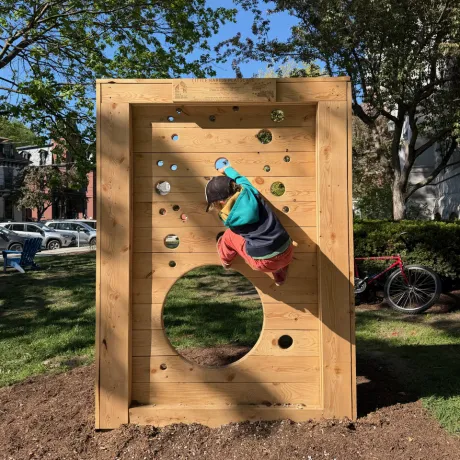
Drawing angles on paper is one thing. Building a public space a community will use every day is something else entirely.
This spring, students in Norwich University’s Design+Build studio saw that reality firsthand as they moved beyond models and renderings to design and construct a new playscape for the Kellogg-Hubbard Library in downtown Montpelier. Under the guidance of architecture professor Tolya Stonorov, students worked with library leaders, community members, and one another to turn ideas into a permanent civic space.

Rooted in a long-standing Vermont tradition, Design+Build combines architectural design with physical construction, requiring students to move beyond theoretical concepts and take responsibility for bringing projects to life. In Stonorov’s studio, students were involved in every stage of the process, from early planning and conceptual design to budgeting, community outreach, construction logistics and material coordination.
Nothing was abstracted away from the students. They worked directly with community partners, tracked costs, coordinated timelines and even accounted for the thousands of screws used throughout the build.
The approach reflects a core principle of Design+Build: when students both design and construct a project, they are fully responsible for the outcome.
Norwich’s approach to Design+Build extends beyond the university studio. This summer, Norwich University’s Architecture + Art program will host its annual Summer Design Academy, a week-long immersive experience introducing high school students to design thinking, architectural composition and hands-on model building.
Running June 21–26, the academy gives students the opportunity to explore architecture through sketching, drafting, workshops, critiques, and collaborative studio work while developing portfolio materials and learning directly from Norwich faculty and practicing architects. Participants will design a small building using drawings and models to explore how architecture is experienced and constructed.
Like Norwich’s Design Build studio itself, the Summer Design Academy reflects Norwich’s emphasis on learning through participation, collaboration and responsibility. For students in Stonorov’s studio, those lessons extended far beyond drawings and models as the Kellogg-Hubbard playscape highlights moving from concept to construction.
Registration is open for students who will be high school sophomores, juniors and seniors in Fall 2026. More information is available online.
Leadership Through Building
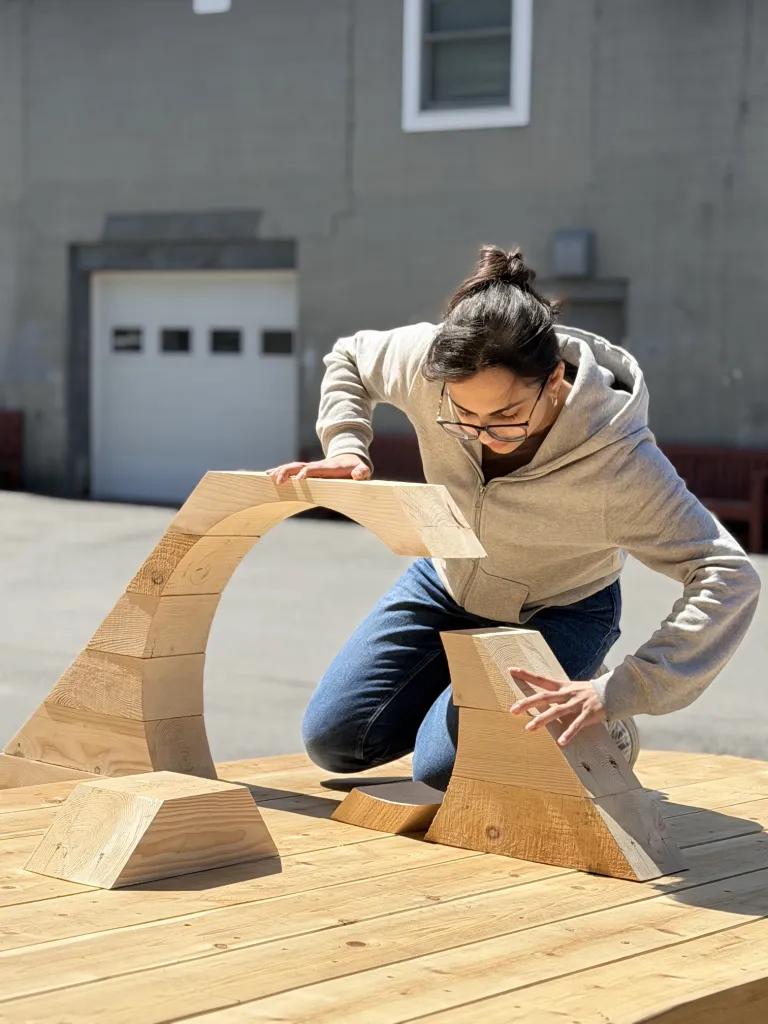
To manage the complexity of the project, students were divided into leadership groups, each responsible for a different aspect of the build.
Students served as project management, construction coordination, social media coverage, community outreach and budgeting. Stonorov intentionally structured the studio so students would take real ownership of the process, not simply contribute ideas. As the project evolved, students learned to navigate collaboration, shifting plans and public responsibility together.
One area Stonorov is firm on in building from a strong foundation is ensuring consensus is established within the group before the project moves forward. The process emphasized shared investment and collective responsibility from the start, helping students navigate collaboration more effectively throughout the project.
“One of my favorite parts of the project is seeing people emerge as leaders,” says Stonorov.
The project challenged students to think beyond aesthetics and consider how their decisions would affect the people using the space every day. Students met with community members, gathered feedback and adapted designs throughout the process as they balanced creativity with accessibility, safety, and the realities of construction.
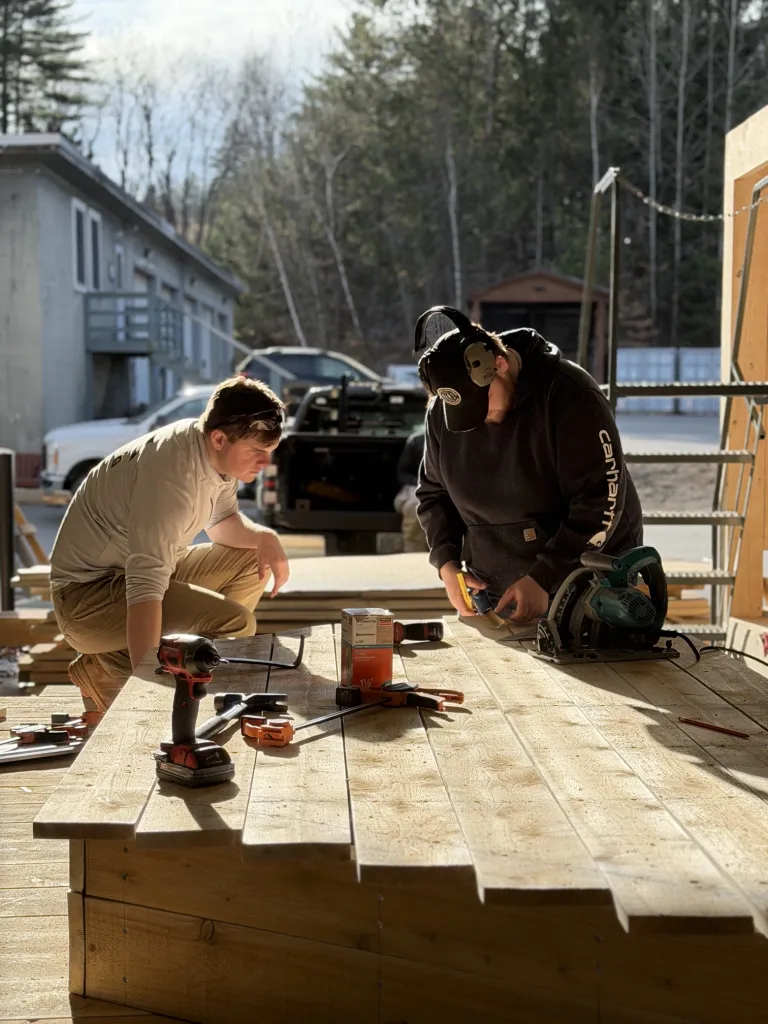
“You are 100% responsible and have to truly understand what the line on the page means,” says Stonorov. “It’s very easy to draw diagonals, to draw angles. It’s much harder when you go to build it.”
Throughout the semester, students presented designs to community stakeholders, gathered public feedback and revised plans as the project evolved. The process required students to balance creative ideas with practical concerns ranging from accessibility and safety to site visibility and environmental considerations.
“Whenever you have a design in your mind and then someone says, ‘It needs to be another way,’ you have to reorient yourself,” says Stonorov. “We had to roll with it and be really resilient and flexible.”
From Drawings to Full Scale
The project’s physical construction unfolded across multiple campus workspaces, where students moved between prototyping, fabrication, and full-scale assembly. Locally sourced wood was carefully measured, cut, stacked, and prepared as teams worked on interactive climbing walls, rotating cube installations, and structural framing. Students drilled steel supports in the Engineering Metals Lab, assembled climbing panels in the architecture wood shop and tested designs at full scale before installation.
In the Co-Lab and wood shop, students worked through constant adjustments, refining measurements, reworking connections and coordinating construction details together. Newly delivered lumber was sorted, rough-cut, and carefully stacked to allow proper airflow and prevent warping over time. Other teams experimented with laser engraving techniques that revealed natural wood-grain patterns and Vermont-inspired graphics across rotating cube panels designed to encourage tactile interaction and play.
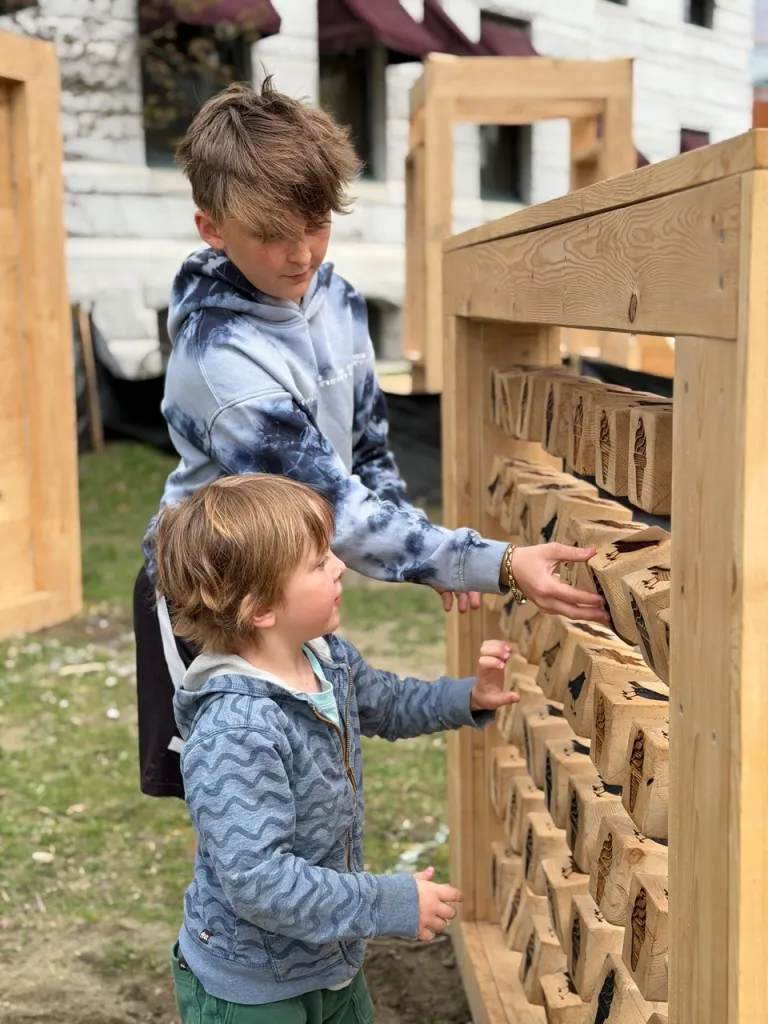
Students also developed mockups of an interactive spinning wall to test spacing, movement and user experience at full scale. The process became both technical and exploratory as students measured angles, drilled steel connections, assembled climbing walls and navigated structural alignment across multiple phases of construction.
What began as sketches and scale models slowly transformed into something physical.
“What once existed only in diagrams, models, and drawings is now beginning to occupy space physically,” one student noted as the structures began taking shape at full scale.
As students laid the pieces across the shop floor, they found themselves walking through and around the structure for the first time, experiencing the scale and spatial relationships of the playscape in an entirely new way. Through trial and error, repeated measurements and constant refinement, the structures gradually came together piece by piece.
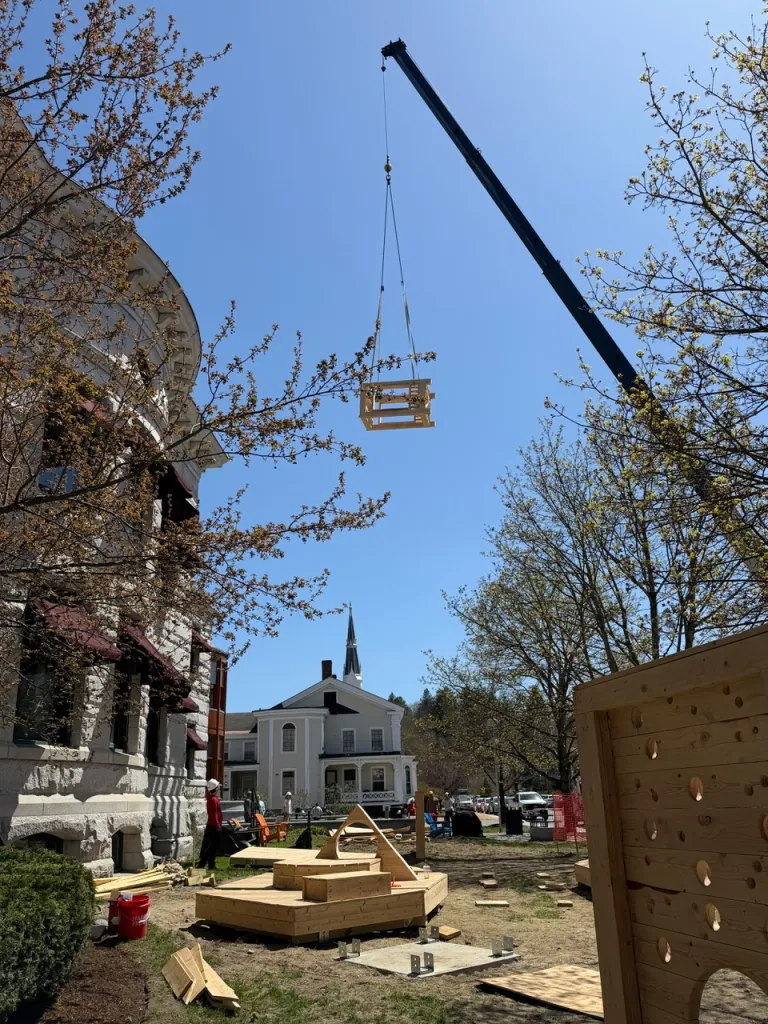
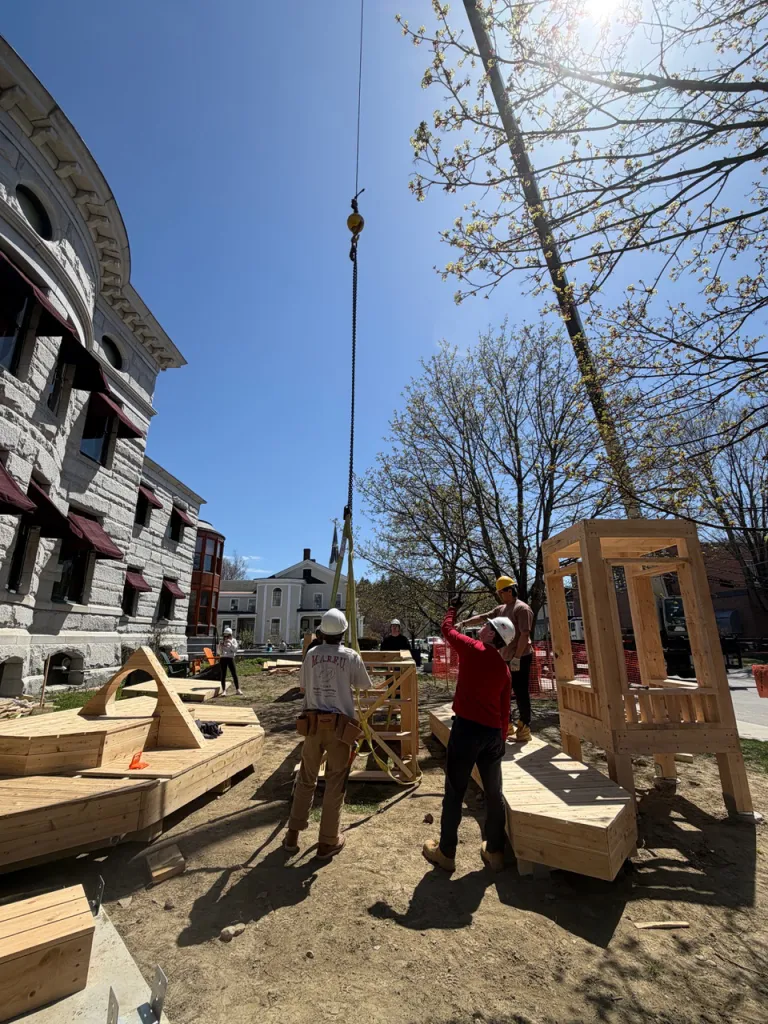
At one stage of installation, one of the larger structures was carefully lifted by crane above the tree line and lowered into place at the library site, a moment that underscored the scale, complexity and precision of the work students had spent months designing and building.
For Stonorov, the project was always about more than completing a structure. The playscape was designed not only for children, but for families, caregivers and the broader Montpelier community moving through the downtown space.
“It’s not just for kids. It’s for the caregivers, the parents, grandparents, and the community,” says Stonorov.
Throughout construction, community members regularly stopped by the site to ask questions, thank students and watch the project take shape. One young girl who participated in an early design workshop later returned during installation to observe the playscape being built — a moment that reflected how deeply the community had connected with the project before it was even complete.
For the students involved, the project became more than an exercise in architecture or construction. It became an opportunity to contribute something lasting to the community while learning how leadership emerges through accountability, collaboration, and shared responsibility.
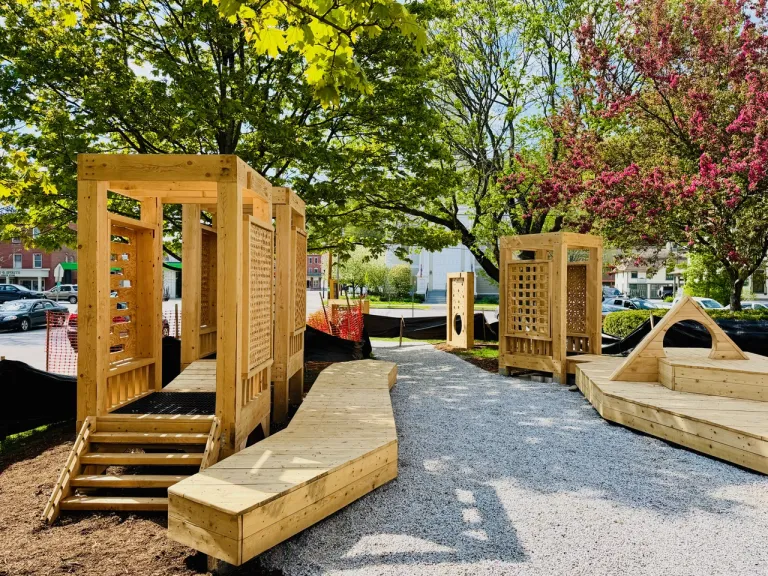
“As architects, we have a great responsibility to give back,” says Stonorov.
The Design Build program is rooted in Norwich University’s long-standing emphasis on developing citizen architects. This translates to designers who understand that architecture carries a responsibility not only to structures, but to the communities those structures serve.
Through projects like the Kellogg-Hubbard playscape, students learn how design, collaboration and public engagement come together to create spaces that support connection, play, and community resilience.
Visit these online pages to learn more about Norwich University’s Design Build program and Summer Design Academy.
Read More
Learning in the Field
By Dr. Michael Gangone
Engineering students take their learning into the field as they visit major infrastructure projects.
2 min read
Architecture in Action: Students Present During Homecoming
By NU Marketing & Communications Office
Architecture students present their work during Homecoming, one of the University's busiest weekends on campus.
2 min read

2026 Military Writers’ Symposium: How Cinema Shapes Our Perception of War
By Zack Bennett
Two days of programming on media and war features student research, expert panels, and a look at Darby’s Rangers.
3 min read