
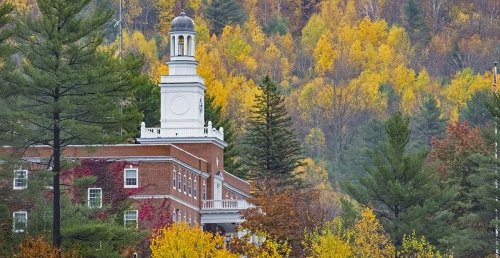
Convocation

Convocation marks the official opening of the academic year at Norwich University. This annual tradition brings together the entire university community to celebrate the start of a new academic year, recognize the accomplishments of our students, and reaffirm our shared commitment to learning, leadership, and academic excellence. 

As one of the main occasions when students, faculty, and staff gather as a single community, Convocation reflects the university's enduring traditions and its dedication to student success.

Awards Ceremony Program

Wednesday, Sept. 2, 2026
2:30 p.m., Shapiro Field House

Program ItemPresenter or Participant
Processional and National Anthem*Regimental Band and Choir
Invocation*Reverend William S. Wick
Welcome and AddressDr. Lea Williams, Provost and Dean of the Faculty
Student SpeakerJose Velasco
Student AwardsDr, Lea Williams, Provost, Dr. Marv Lutnesky, Dean of the College of Arts and Sciences, and Aron Temkin, Dean of the College of Professional Schools
Kay Bowen Staff Recognition AwardsLtGen John J. Broadmeadow, USMC (Ret), Norwich University President
2025-26 Faculty Tenure and PromotionsCharles A. Dana Professors
Closing WordsProfessor Sean Prentiss, English
Concluding RemarksLtGen John J. Broadmeadow, USMC (Ret), Norwich University President
Alma Mater*Regimental Band and Choir
Recessional*Regimental Band
Dr. Mark Parker, master of ceremonies

*Audience is requested to stand or remain standing.


Norwich Forever

Norwich forever, queen of the hills,
When far from thee, still memory thrills recalling
Scenes and old friendships, songs and old cheers,
Memories that fade not through the changing years.

Awards

Endowed by the Dana Foundation in 1974, these professorships are awarded to tenured, full professors of outstanding ability who possess high scholarly attributes, demonstrate leadership qualities that have earned them the respect of their colleagues, and have significantly influenced the life of the University.

Francis Cox, English
Richard Dunn, Geology
Elizabeth Gurian, Criminology and Criminal Justice
Daniel McQuillan, Mathematics
Darlene Olsen, Mathematics
Huw O.L. Read, Cybersecurity & Advanced Computing
Steven Sodergren, History

Established by former President Dr. Homer L. Dodge in 1970, the biennial Dodge Award for Excellence in Teaching is awarded to a faculty member in the early stages of their professional career who makes a distinguished contribution to the academic life of the University through outstanding teaching.

Rowland Brucken, History 
Megan Doczi, Biology 
Sarah Gallant, Chemistry
Emily Gray, History
Tara Kulkarni, Engineering
William Travis Morris, Criminology and Criminal Justice
Allison Neal, Biology
Darlene Olsen, Mathematics
Robert Poodiack, Mathematics

Presidential Fellows serve as student liaisons to the Board of Fellows visiting committees and are selected based on evidence of exceptional academic performance.

College of Arts & Sciences

Alexander Dechene, Criminal Justice
Azalea Khanal, Mathematics
Sami Molu, Health Science
Sophia Taylor, Criminal Justice

College of Professional Schools

David Besserer, Nursing (Accelerated)
Sabian Garcia, Architectural Studies
Heinrich Hayden, Business Management
Victoria Jarvis, Computer Science and Information Systems
Fatihat Quadri, Mechanical Engineering

Sarah Harris
Manager

Vanessa Middleton
Administrative Support

Mary O'Callaghan
Service

Promotions

Angie Carpenter-Henderson
Senior Lecturer, Health and Human Performance

Chauntelle Eckhaus
Senior Lecturer, Mathematics

Steven Hrotic
Senior Lecturer, Sociology

Irene Newsham
Senior Lecturer, Chemistry and Biochemistry

Sean Kramer
Full Professor, Mathematics

Carl Martin
Full Professor, English

Llynne Kiernan
Full Professor, Nursing

Tolya Stonorov
Full Professor, Architecture and Art

Jason Galligan Baldwin
Full Professor, Architecture and Art

Carolin Payares-Aspirino
Full Professor, Mechanical Engineering

Promotion and Tenure

Matthew Fisher
Associate Professor, Criminology and Criminal Justice

Sarah Gallant
Associate Professor, Chemistry and Biochemistry

Scott Smith
Associate Professor, Mechanical Engineering

Tenure

Matthew Bovee
Computer Security and Information Systems

Gowns, hoods, and caps comprise the distinctive dress of the academic profession. Originally developed in the Middle Ages, they served to distinguish both students and faculty as university members and to provide protection from the cold, both indoors and out, since medieval buildings were unheated. They were worn daily in most American universities until the Civil War. Today they are colorful accessories to academic ceremonies and rituals.

The style of the gown indicates the degree obtained by the wearer. The bachelor's gown has short, square sleeves and is worn closed. The master's gown has oblong sleeves, and the doctor's gown has bell-shaped sleeves. Both gowns may be worn open or closed. Velvet trimmings, including facings down the front and sleeve bars, also distinguish the doctor's gown.
The color of hood edgings and trimmings on doctors' gowns generally indicates the discipline of the wearer: white — arts, letters, and humanities; crimson — journalism; scarlet — theology; purple — law; green — medicine; apricot — nursing; dark blue — philosophy; yellow — science; brown — architecture; pink — music; lilac — dentistry; orange — engineering; olive green — pharmacy; drab — business; lemon yellow — library and information science; light blue — education; peacock blue — international affairs; and citron — social work.

The hood’s coloring and size represent the type and subject of the degree earned, as well as the institution from which it was awarded. Hoods differ according to degrees. The bachelor’s hood is three feet in length, the master’s is three and one-half feet, and the doctor’s is four feet long. The edging of the hood varies in width as well for the three degrees: two, three, and five inches, respectively. Tassels on caps are black for bachelor’s and master’s degrees; doctors may wear gold tassels on their caps. 

A college or university president frequently wears the symbol of the office of president, a key or a medallion, over the academic gown.