
Engineer, Soldier, Builder: Iowa PBS Documentary Revisits the Remarkable Life of Grenville Dodge, Class of 1851
A recent Iowa PBS documentary traces the life of the Norwich University graduate who became a Civil War general, intelligence pioneer, congressman, and chief engineer of the Union Pacific Railroad.
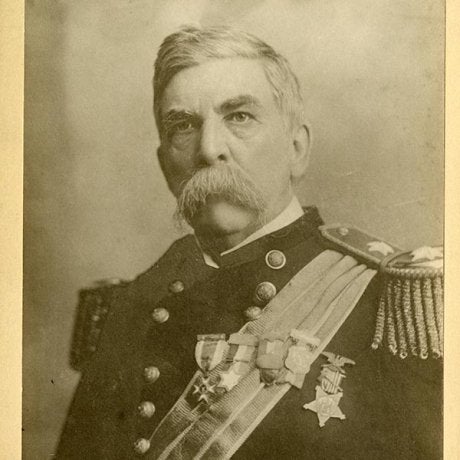
Watch "General Dodge and the Transcontinental Railroad" from Iowa PBS.
Before Grenville Dodge helped lay the steel that connected a continent, before he became a major general, intelligence pioneer, or one of the most consequential railroad engineers of the 19th century, he was a young Norwich cadet learning that education mattered most when knowledge was put into action.
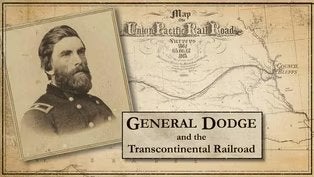
More than 175 years after graduating from Norwich University in 1851, Iowa PBS is bringing his remarkable story to a new generation through the documentary "General Dodge and the Transcontinental Railroad." Released June 15, 2026, the 56-minute film examines Dodge as a soldier, spymaster, and builder whose career intersected with the Civil War, Abraham Lincoln, and the construction of the first transcontinental railroad.
For Norwich, the documentary tells another story as well.
It is also the story of Captain Alden Partridge’s educational vision put into practice – an education intended not simply to prepare graduates for a profession, but to prepare them to serve wherever circumstances demanded their talents.
Grenville Dodge spent a lifetime doing exactly that.
An Engineer Begins at Norwich
Dodge arrived at Norwich during an era when the United States itself was still being built.
Railroads were pushing west. Cities were expanding. The country needed engineers capable of turning plans into roads, bridges, and infrastructure that could cross difficult terrain.
Norwich was already preparing them as the first private college in the United States to offer formal instruction in civil engineering, a natural outgrowth of Partridge’s conviction that education should combine academic study with practical application. Dodge graduated from Norwich as a civil engineer in 1851 and almost immediately headed west to begin surveying railroad routes.
The Iowa PBS documentary spends time on those formative years, tracing Dodge’s early interest in railroads and his path to Norwich before following him west. His first railroad work was hardly glamorous. He joined a survey crew as an axeman, clearing brush so other members of the crew could take measurements through the largely undeveloped terrain.
The Engineer Goes to War
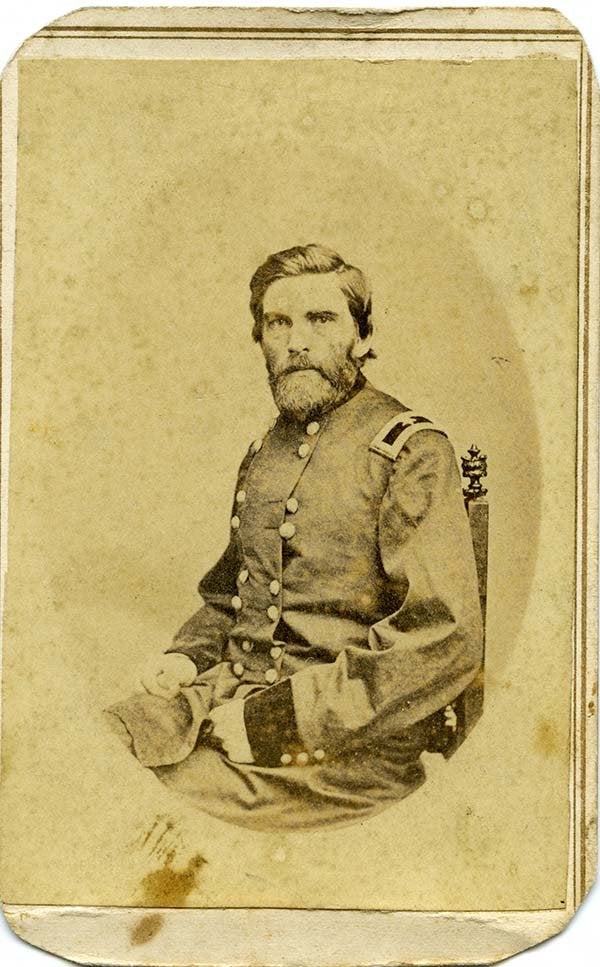
When the Civil War began in 1861, Dodge exchanged surveying instruments for military command.
Commissioned as a colonel in the 4th Iowa Volunteer Infantry, he distinguished himself at the Battle of Pea Ridge in Arkansas and was promoted to brigadier general in 1862. Two years later, still in his early 30’s, he was promoted to major general. MG Dodge would command the XVI Corps during General Sherman’s Atlanta Campaign.
Even in military service, he never stopped being an engineer. Railroads were the logistical arteries of the Civil War, moving soldiers, equipment, and supplies. When Confederate forces destroyed tracks and bridges, General Dodge’s units became exceptionally effective at rebuilding them. His engineering experience helped keep critical Union transportation networks operating under conditions far removed from a classroom or drafting table.
The Iowa PBS documentary also explores a lesser-known part of General Dodge’s wartime service as he became an intelligence pioneer. While stationed in Corinth, Mississippi, he expanded an existing scouting operation into a network that eventually included more than 130 agents operating across the South. Information gathered through the network helped Union commanders track Confederate troop movements during some of the war’s most important campaigns.
Engineer. Soldier. Intelligence officer. Those roles may appear disconnected, but for General Dodge, they were different applications of the same skills: gather information, understand the problem, organize people and resources, and act. It was an approach with deep roots in his Norwich education.
Years later, General Dodge reflected on just how important his Norwich experience had been:
“My military training at Norwich was of as much or more benefit to me, generally, perhaps, in the work I had to undertake, than what I had learned of engineering, for it taught me how to command men, it gave me discipline, a respect for authority, obedience to order, loyalty to my country, and an interest in the work of my employer.”
Connecting a Continent
While surveying across Iowa and beyond, a young Grenville Dodge became convinced that the Platte River Valley offered the most practical pathway for a railroad to the Pacific. In 1859, in Council Bluffs, Iowa, he discussed western railroad routes with Abraham Lincoln, then an Illinois lawyer and future president. The route Dodge described would closely resemble the path eventually followed by the Union Pacific Railroad.
The conversation took on greater significance after Lincoln became president and signed the Pacific Railway Act of 1862. Following the Civil War, Dodge resigned his military commission. In 1866, he became the chief engineer of the Union Pacific Railroad.
The challenge was immense. At the end of 1865, Union Pacific had laid only about 40 miles of track. With Dodge directing engineering in the field, the railroad pushed rapidly westward across the Great Plains and through the Rocky Mountains toward its eventually meeting with the Central Pacific at Promontory Summit, Utah.
On May 10, 1869, the joining of the railroads created the nation’s first transcontinental rail connection, linking existing eastern rail networks with the Pacific Coast and fundamentally changing the movement of people, goods, and information across the continent.
Service Beyond the Railroad
While serving as Union Pacific’s chief engineer, he was elected to the U.S. House of Representatives from Iowa and served in the 40th Congress from 1867 to 1869. He remained deeply involved in railroad development across the country.
Additionally, he stayed profoundly connected to Norwich University.
General Dodge served as a Norwich University trustee from 1882 until his death in 1916. He provided important financial support to the University, helped establish Norwich’s permanent endowment, and funded the research, compilation, and publication of the three-volume "History of Norwich University, 1819-1911," preserving the history of the institution that had helped prepare him for his own extraordinary life of service.
The Citizen-Soldier in Practice
Captain Alden Partridge founded Norwich on an idea that was unusual in American higher education: that a person educated for the responsibilities of citizenship should be capable of contributing in both peace and war.
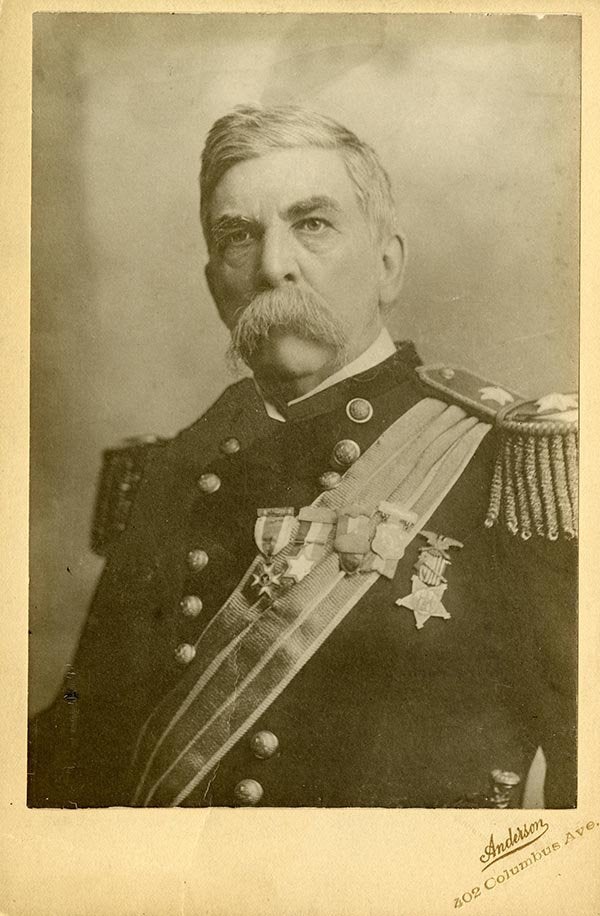
In 1951, as Norwich prepared to mark the 100th anniversary of Dodge’s graduation, President Harry S. Truman sent a letter from the White House. President Truman wrote, “I have heard with great interest of plans of Norwich University to celebrate in Northfield next Saturday the one hundredth anniversary of the graduation of pre-eminent engineer and citizen-soldier, Major General Grenville M. Dodge.”
At the same celebration, Major General Ernest N. Harmon, USA (Ret.), President of Norwich University, described the ideas that had shaped Partridge’s educational philosophy. “Captain Partridge had two ideas which were revolutionary in the thinking of his day on educational matters. He conceived the idea of making education a more practical tool for living.” Later, MG Harmon continued, saying “His second idea was that military instruction was an essential and highly useful addition to the civil education of his students and would qualify them for the correct and efficient discharge of their duties when the country might require their services.”
Grenville Dodge became one of the most vivid demonstrations of that citizen-soldier ideal.
Read More
What Lasts: Stories from Norwich Homecoming
By Corrina Snow
At Norwich University’s 2026 Homecoming, alumni returned to Northfield to reconnect, share memories, and celebrate relationships that extend long after graduation.
6 min read
Athletics: Zacher selected for NCAA Division III Athletic Communicators Emerging Elite Program
By Norwich Athletic Communications
This link takes the reader to an external article.
Remembering Roger H. Damon, Class of 1951
By NU Marketing & Communications Office
The Norwich community remembers a beloved classmate.
13 min read