
Carrying on the Partridge Idea
A piece of Norwich history inspires education for students of the future.
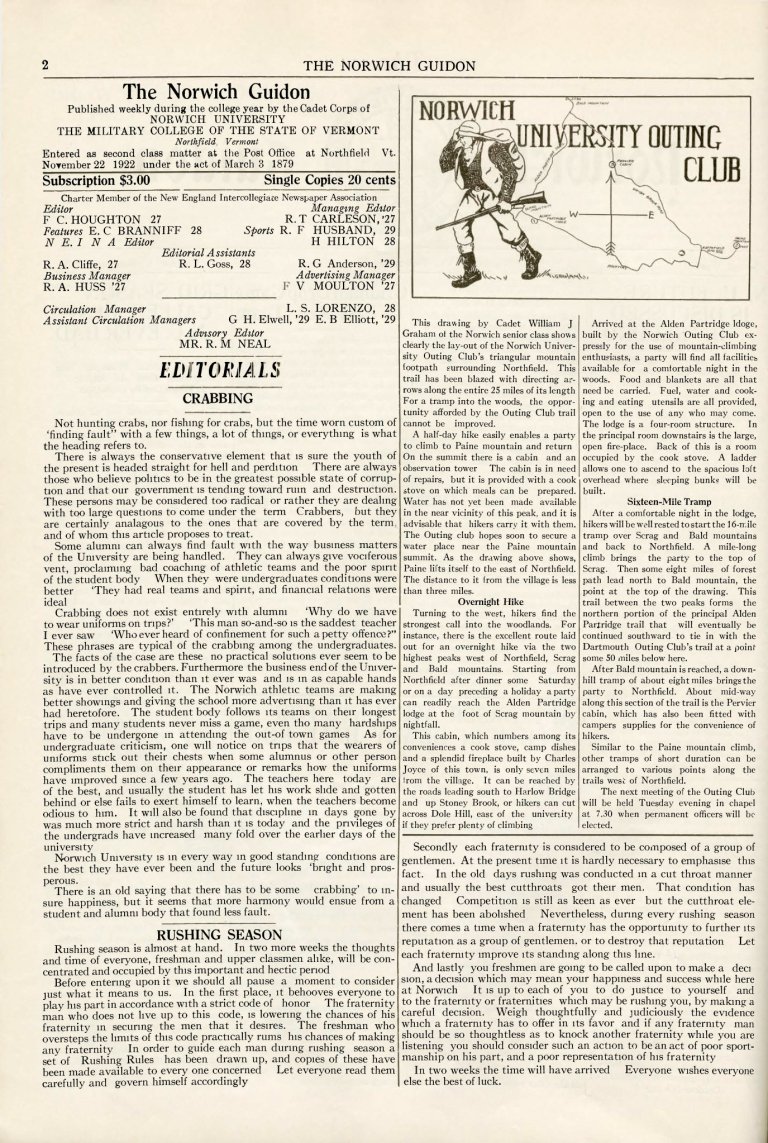
The object of this club shall be to co-operate with the university and the community in carrying on the Partridge idea of developing ‘a sound mind in a sound body’ through the promotion of camping, snow-shoeing, skiing, wood craft, trail building and other similar outdoor activities.
— Constitution of the Norwich Outing Club, 1927 (“Norwich University Outing Club,” Record 181)
I was scanning the pages of the Northfield News and Advertiser from the 1920s, browsing the record of our small Vermont town when an item caught my attention. It announced that the Norwich Outing Club had plans to build an ambitious mountain trail, which would be named for Alden Partridge, the University’s founder, and would stretch from Northfield south to connect with the Dartmouth Outing Club trail. Cabins would be erected at intervals. The route would be chosen to include, as the cadets themselves put it, “the most beautiful spots of the region through which it runs” (“Plans” 6).
I was fascinated by the energy these students had as they blazed trails, built shelters, and opened up the mountains surrounding their campus for anyone who wanted to use them. They did it because, as the Guidon noted in November 1922, “There are many at Norwich who love outdoor life and this project will provide an outlet for their feeling” (“Plans”). That simple sentence and sentiment resonated.
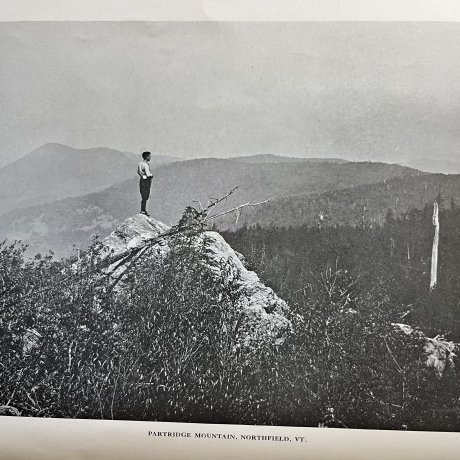
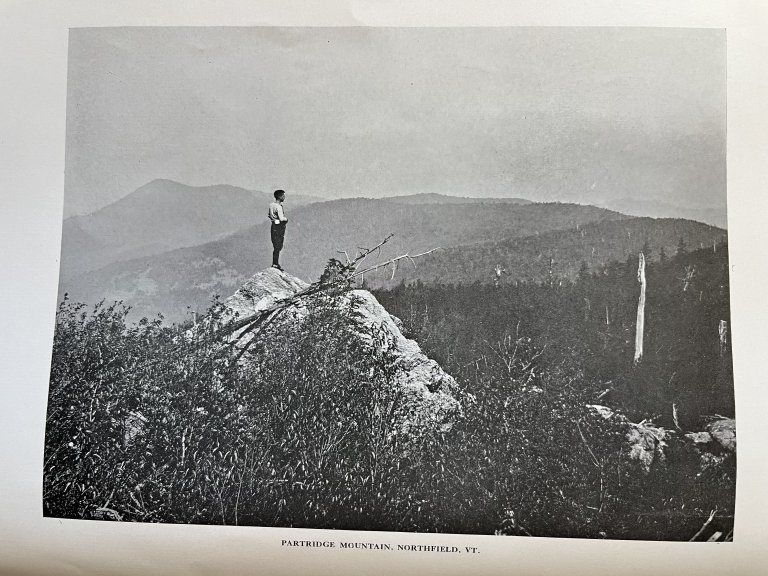
By November, the Outing Club had started construction on a cabin on Scrag Mountain, roughly six miles from campus (“Plans”). The students planned “to cut and blaze a trail south to Norwich, Vermont, and past the site of the Old South Barracks, where it will tie in with the Dartmouth Outing Club trail. The trail will be known as the Alden Partridge Trail in honor of the founder of Norwich University” (“Plans”). The students intended to construct additional extensions “northwest to Camel’s Hump and west to Potato Hill, two important points on the Long Trail” (“Plans”). News of the project reached well beyond Northfield: the Burlington Free Press reported on the new cabin and winter plans on Nov. 30, 1922 (“New Cabin” 2), and just days later the Boston Globe published a photograph of a student — later identified in a Dec. 5, 1922 article in the News and Advertiser as Fletcher Plumley — “on the Alden Partridge Trail, which is being blazed through Vermont by the Norwich University Outing Club,” bringing the cadets’ work to the attention of readers across New England (“View” 78; News and Advertiser, 5 Dec. 1922, 8).
While the students sought to build a trail parallel to the Long Trail, and some, such as state forester Wilmont G. Hastings, believed it was “even more inviting to the outdoor hiker than [the] Long Trail” because it provided an “excellent view of the western range” (“New Cabin” 2), they primarily focused on creating a system that would eventually encompass a triangular network connecting the three highest peaks surrounding Northfield — Scrag Mountain at roughly 2,900 feet, Bald Mountain at approximately 2,500 feet, and Paine Mountain at about 2,400 feet — with the trail between Scrag and Bald forming the main artery of what they named the Alden Partridge Trail (“Norwich University Outing Club,” Guidon 2; “Norwich University Outing Club,” News and Advertiser 3; “Norwich University Outing Club,” Record 180-81).
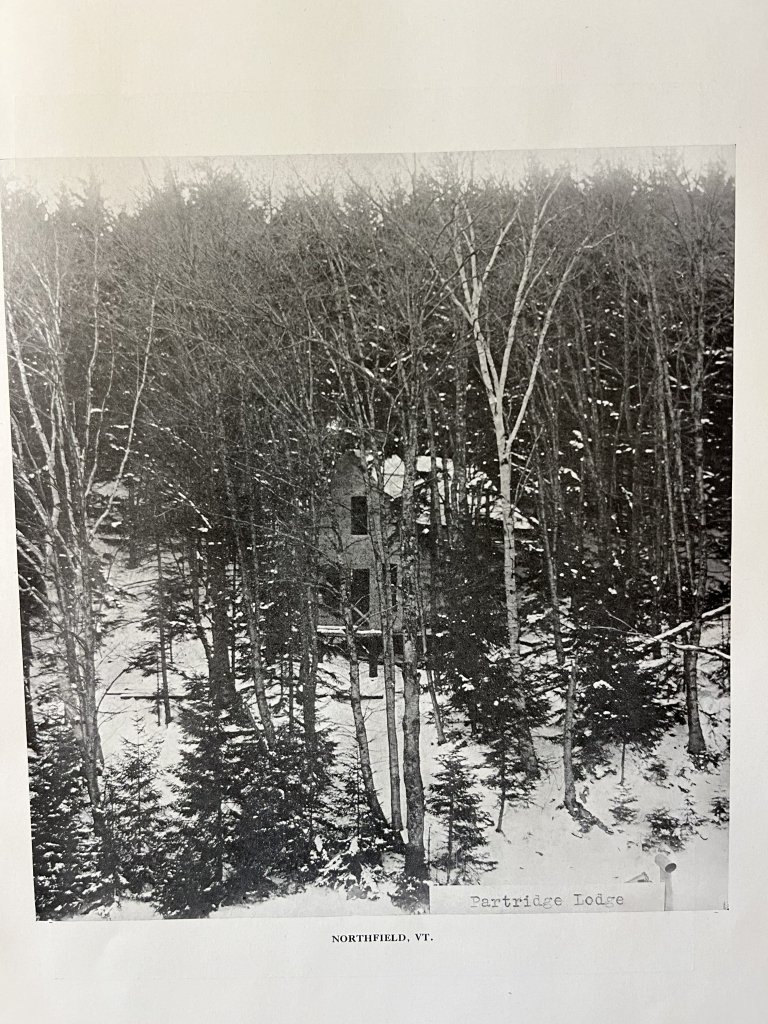
Over the next several years, working through winter breaks, summers, and weekends, students blazed and cleared miles of trail, erected cabins at the foot of Scrag Mountain, at the base of Bald Mountain, and on top of Paine Mountain. Of particular note was the Alden Partridge Lodge at the base of Scrag Mountain, a cabin with four rooms, a stone fireplace built by Charles Joyce of Northfield, a cook stove, kitchen utensils, sleeping bunks, and windows that filled the rooms with light; it could accommodate 20 people and was open to anyone who wished to use it (“Norwich University Outing Club,” Guidon 2; “Norwich University Outing Club,” Record 180). By 1926, Cadet William J. Graham, who would become president of the Outing Club, drew a hand-illustrated map of the trail system that was published in the Guidon, the Norwich University Record, and the local newspaper, showing the triangular route surrounding Northfield with its cabins and arrows blazed along the roughly 25 miles of trail (“Norwich University Outing Club,” Guidon 2; “Norwich University Outing Club,” Record 180; “Norwich University Outing Club,” News and Advertiser 3).
What struck me most, reading through these accounts, was how the students understood the Outing Club’s work as embodying the deepest values of Norwich itself. The Guidon editorialized in October 1925 that the Alden Partridge Trail was “distinctly a Norwich project” and “a most worthy project and one that deserves attention from the Corps” (“Editorials” 2). The editors urged students to see the trail as their own and to give the Outing Club their full support. “We feel that with the help of the student body, financially and materially and with their combined interest back of the projects,” they wrote, “the Outing Club can make a name for itself and Norwich” (“Editorials”).
The Outing Club’s constitution made the philosophical connection explicit. Its objective was “to co-operate with the university and the community in carrying on the Partridge idea of developing ‘a sound mind in a sound body’ through the promotion of camping, snow-shoeing, skiing, wood craft, trail building and other similar outdoor activities” (“Norwich University Outing Club,” Record 181), a deliberate invocation of Alden Partridge’s founding philosophy, the conviction that physical vigor, practical skill, and intellectual cultivation were inseparable. The cadets who hauled logs and stones to build the lodge at the base of Scrag Mountain understood themselves to be continuing a tradition that went back to the founding of their university in 1819.
What made the timing of the Alden Partridge Trail especially significant was how it aligned with a broader movement to draw visitors to Vermont for its natural beauty. In the early 1920s, Vermont was waking up to the economic potential of tourism — and to the fact that neighboring states were doing a better job of capitalizing on their landscapes. A Burlington Free Press editorial on April 2, 1923, urged concerted efforts to publicize Vermont’s untapped scenic resources (“Editorial” 5), and a Boston Herald article appeared around the same time under the evocative headline “Selling Vermont” (“Vermont Scenery” 2).
The Guidon seized on these ideas with enthusiasm. The April 1923 editorial, “Vermont Scenery and the Alden Partridge Trail,” framed the Outing Club’s work as part of this statewide effort. The editorial noted that Maine’s natural beauty had brought tourists who spent $45 million in a single year, and that New Hampshire enjoyed far greater tourist traffic than Vermont despite having scenery that was no more alluring. The Norwich Outing Club, the editors wrote, had “a splendid opportunity in opening up the Alden Partridge Trail over a section of the mountains of Vermont that tourists and lovers of the great out of doors will not be slow to appreciate and use. In pushing this project forward to successful completion Norwich men will be performing a pleasant service which will be a help to the State and a credit to the University and themselves as well” (“Vermont Scenery” 2).
In 1926, the Alden Partridge Trail and Lodge were featured in a photobook, published by the Central Vermont Railway Company, designed to attract tourists to Vermont (News and Advertiser, 27 July 1926, 1). In 1927, the Northfield Chamber of Commerce produced a pamphlet highlighting the trail as one of the town’s attractions (News and Advertiser, 19 July 1927, 1). The trail’s prominence even touched national politics: in February 1927, the Boston Globe reported that Vermonters sought to rename Bald Mountain — one of the three peaks on the Alden Partridge Trail — as Mount Coolidge, in honor of the state’s native son in the White House, noting that the peak was maintained by the Norwich University Outing Club (“Vermont May Honor” 32). The cadets’ project had become woven into the public identity of the region. What began as a student initiative had become a civic asset — proof that the work of education and the work of community could be one and the same.
This story captivated me as I thought about the effort that was invested in building lodges and blazing miles of trails in the Vermont woods. Those students wanted to be outside and to apply what they were learning — surveying, engineering, leadership, planning, collaboration — to something real that would endure beyond their time on campus. They also wanted to serve their community, to contribute something of value to the State of Vermont and the town of Northfield. These impulses, the desire for the outdoors, for practical application, for building, for service, is at the heart of what we now call the Outdoor School initiative at Norwich University.
The Outdoor School, as defined in the University’s pilot program for summer 2026, combines academic exploration, practical leadership development, and civic responsibility through immersive outdoor education. Building upon Partridge’s vision of educating “citizen-soldiers,” it integrates Norwich’s military heritage with contemporary outdoor education to create citizen-leaders prepared for both civilian and military service.
This initiative is not new but is a rediscovery. The students who blazed the Alden Partridge Trail were already doing what the Outdoor School aspires to do: they were learning by doing, in the outdoors, in service to something beyond themselves. Building trails and lodges requires planning, physical endurance, teamwork, navigation, resource management, and a vision for how the finished product will serve others. It is, in short, an education.
This reading and research led to asking the question: can we recover the spirit that motivated the students in the Outing Club in the 1920s? Those participating in its activities honored the past, Alden Partridge’s founding vision, while creating something tangible for the future. The Outdoor School initiative aspires to do the same while recognizing the importance of the connection between the University and its place. The students constructed trails in the mountains that surrounded their campus, building in a specific place, for specific neighbors, as part of a specific community. The trail was, from the beginning, a shared project between the University and the town.
A hundred years ago, a group of Norwich students looked at the mountains around their campus and organized, raised funds, built cabins, cleared paths, and opened the mountains to those who wanted to venture into them. They called it carrying on the Partridge idea. We might call it the Outdoor School. The name matters less than the spirit — that restless, constructive, generous impulse to go outside, to build something real, and to bring others along — is waiting to be rediscovered.
This summer, the Outdoor School takes its first steps from idea to action with a set of pilot courses that bring learning outdoors and into the community. Interested students are encouraged to explore the offerings below and register for summer classes; more information is available online, and those who want to learn more about the Outdoor School initiative should contact provost@norwich.edu.
Works Cited
“Editorial.” The Burlington Free Press, 2 Apr. 1923, p. 5.
“Editorials.” The Norwich Guidon, 23 Oct. 1925, p. 2.
“New Cabin Built on Alden Partridge Trail.” The Burlington Free Press, 30 Nov. 1922, p. 2.
News and Advertiser [Northfield, VT], 5 Dec. 1922, p. 8.
News and Advertiser [Northfield, VT], 27 July 1926, p. 1.
News and Advertiser [Northfield, VT], 19 July 1927, p. 1.
“Norwich University Outing Club.” News and Advertiser [Northfield, VT], 16 Nov. 1926, p. 3.
“Norwich University Outing Club.” The Norwich Guidon, 19 Nov. 1926, p. 2.
“Norwich University Outing Club.” Norwich University Record, vol. 18, no. 15, 15 Jan. 1927, pp. 180-
81.
“Plans of the Outing Club.” The Norwich Guidon, 15 Nov. 1922, p. 6.
“Vermont May Honor Her Most Distinguished Living Son by Naming Mountain Peak for Him.”
The Boston Globe, 10 Feb. 1927, p. 32.
“Vermont Scenery and the Alden Partridge Trail.” The Norwich Guidon, 12 Apr. 1923, p. 2.
“View of Surpassing Beauty.” The Boston Globe, 3 Dec. 1922, p. 78.
Summer 2026 Outdoor School Pilot Courses
Writing & Inquiry in Public Contexts (WRIT 110)
Gen Ed Goal 1, Critical Reading, Writing, and Research
Prof. Dalyn Luedtke
Offered: July 6-August 7 (5 weeks): MTWR 1000–1215
Students investigate how different communities, including hikers, bikers, conservationists, and local residents, hold distinct values regarding shared public spaces such as Paine Mountain trails and the Dog River. Through observation, exploration, and interviews, students develop critical thinking and rhetorical skills while examining complex public issues connected to Norwich’s physical environment.
Art & Landscape: Walking VT’s Environmental History (FA 250)
Gen Ed Goal 3, Humanities
Prof. Christina Shivers
Offered: June 22–August 7 (7 weeks): TR 900–1215
Students will develop a knowledge of Vermont’s socio-environmental and landscape history through a series of outdoor guided hikes and walks in Norwich University’s forest and campus, Northfield Town Forest, and Paine Mountain. Each outdoor instructional session will be paired with a form of artistic representation historically used to document and describe nature: Abenaki myths, landscape paintings of the Green Mountains, granite monuments, historic photographs, and travel posters.
Psychology of Leadership (PY 210)
Gen Ed Goal 8, Leadership
Prof. Sean Beebe
Offered: June 22–August 7 (7 weeks): M 1230–1330; T 1230–1800
Students examine motivation, teamwork, emotional intelligence, and ethical decision-making through classroom instruction, reflection, and progressively extended field experiences. Archival study of Alden Partridge’s educational philosophy anchors the course, with each setting serving as a living laboratory for leadership in practice.
Eco Detectives: Methods in Field Research (BI 299/ES 299)
Gen Ed Goal 4, Natural Sciences
Prof. Lindsey Pett
Offered: June 22–August 7 (7 weeks): MW 1300–1730
Through hands-on experience in forests, wetlands, streams, and meadow environments, students learn to design and implement field studies while developing technical skills essential to ecological and wildlife research. The course emphasizes data accuracy, statistical sampling design, and the interpretation of biological data in the context of habitat assessment and conservation management.
Public History in the Field (HI 260)
Gen Ed Goal 3, History
Prof. Chris Delmas
Offered: June 22–August 7 (7 weeks): F 800–1430
In partnership with the Northfield Historical Society, students explore how stories of place are preserved through the built environment, oral histories, and public exhibitions. Participants conduct site visits and documentation at the Paine House Museum and surrounding heritage sites, contributing to community-based interpretive projects.
Drones in BIM: Mapping, Modeling & Surveying (EG 299)
Prof. Jack Patterson
Offered: June 22–July 3 (2 weeks): MTWRF 800–1230
This intensive course introduces students to drone mapping, photogrammetry, and site modeling. Students collect and process spatial data using industry-standard tools while reflecting on the civic, ethical, and environmental implications of emerging geospatial technologies.
Student Pathways
Multi-Course Packages (courses within packages do not overlap)
Outdoor + Civic Immersion (13 credits)
- PY 210 – Psychology of Leadership
- FA 250 – Art & Landscape
- BI 299/ES 299 – Eco Detectives
- HI 260 – Public History in the Field
STEM + Writing (10 credits)
- EG 299 – Drones in BIM
- BI 299 – Eco Detectives
- WRIT 110 – Writing & Inquiry in Public Contexts
Outdoor Immersion (10 credits)
- EG 299 – Drones in BIM
- PY 210 – Psychology of Leadership
- BI 299/ES 299 – Eco Detectives
Read More
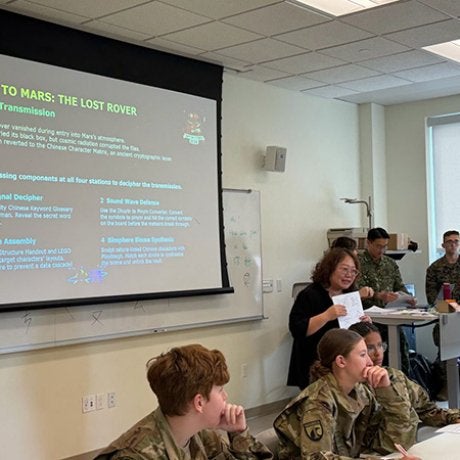
Mars Missions Bring Cybersecurity to Life at Day of Cyber
By Dr. W. Travis Morris
Nearly 300 students and educators explored cybersecurity, robotics and teamwork through hands-on adventures.
3 min read

Norwich Design+Build Studio Wins Regional Architecture Award for Montpelier Playscape
By NU Marketing & Communications Office
American Institute of Architects New England honors student-built Little Rapids Playscape with a 2026 Citation Award.
2 min read

Norwich hosts hundreds of Vermont students for 'Day of Cyber'
By MyChamplainValley
This link takes the readers to an external article.