
To the Sahara and Back: The 2026 Olmsted Expedition
Student-planned and student-led, the field study in Morocco took Norwich cadets from the Medinas to the desert and taught them what no classroom can.
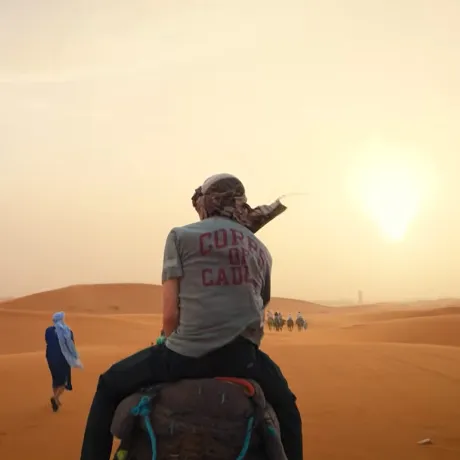
Watch the Olmsted Expedition make their way through Morocco.
In Merzouga, at the edge of the Sahara, C/2LT Jayden Lavecchia ’27 swung onto a camel and rode into the desert with his Norwich classmates. It was the kind of place that belongs in a movie scene.
“That’s not something everyone does. That’s a once-in-a-lifetime experience,” says Lavecchia, operations officer for the 2026 Olmsted Expedition. “It was so much fun, surrounded by people that I like, in the Sahara Desert — which is the textbook definition, dictionary picture to the side: desert.”
Getting there had taken a country’s worth of travel. Over a couple of weeks, a team of Norwich cadets crossed Morocco, whose terrain shifts from mountains to ocean to desert, trading the classroom for the Medinas, the military installations, and the people they came to meet — and behind every stop on the route, from the camels to the conference tables, was a plan the cadets built themselves.
Learning Through Action
The Olmsted Field Study, made possible by the George and Carol Olmsted Foundation, has become an intrinsic part of experiential education at Norwich. Last year, cadets traveled to the Baltic states of Estonia, Latvia, and Lithuania to study peace and security in Eastern Europe, meeting with officials at institutions including NATO’s Center of Excellence for Strategic Communications. This year’s destination offered a very different classroom.
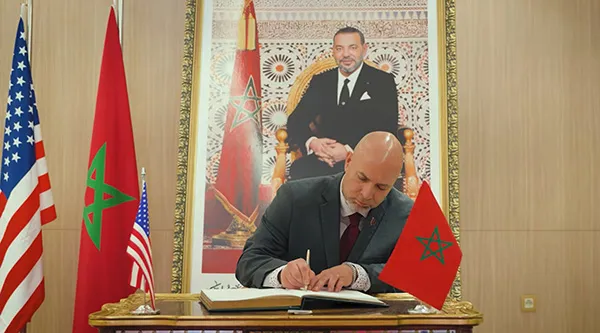
“Norwich University is interested in producing effective leaders, leaders that can lead with allies from other countries, that are comfortable in international situations,” says Dr. Travis Morris, faculty advisor for the expedition and director of the Senator Patrick Leahy School of Cybersecurity and Advanced Computing. “Students got to just experience what it’s like to travel and to navigate in this particular space.”
For Morris, the trip is a direct expression of the University’s founding philosophy. “It’s an immersive, experiential learning opportunity. That’s what Norwich does. That’s what we’ve been doing for over two centuries — and that’s what Partridge wanted us to do,” says Morris.
Leading from the Front
What sets the Olmsted model apart is who does the work. Each cadet on the team held a defined role, from operations and logistics to finance, communications, and cultural affairs. They planned the itinerary, arranged housing and transit, and set up meetings with Moroccan officials and community members.
“The Norwich model is unique because the students plan, and execute, and evaluate the event with some faculty guidance. They’re responsible for managing the logistics on the ground. They are responsible for facilitating some of the meetings that we have with politicians, educators, military leaders, businesspeople, and just average civilians and tour guides,” says Morris. “So, it’s not just a culturally immersive experience. It’s a leadership experience as well.”
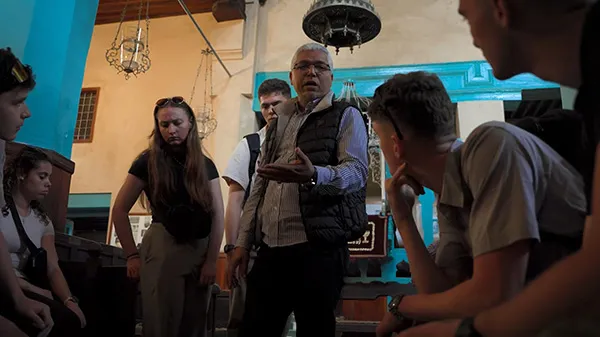
That responsibility was felt most acutely by those handling the logistics. “As the logistics officer on the Olmsted Expedition, trying to plan all the travel routes, all the housing, and all the train situation in the country — which is completely unique to this country — provided me a very good challenge to really push myself,” says C/CPT Austin Garcia ’27, an Army ROTC cadet and international studies major. “Not in an academic sense, but in a practical sense, actually learn about what it is to kind of organize these large trips for 12 people. Twelve people doesn’t sound like a lot, but it’s a huge challenge to really make the flow of the trip work.”
For C/SFC Rebekah Oliveira ’28, the expedition’s communications officer and a Navy ROTC cadet and criminal justice major, the freedom to shape the experience was the lesson itself. “Dr. Morris really let us make this experience the way that we wanted it, the way that we envisioned it, and that will definitely prepare us for the future, especially when we’re junior officers. We’re still going to fail. We’re still going to learn. But we’re going to have a better understanding of how to deal with it and how to learn from it,” says Oliveira.
When the Plan Falls Apart
The ride into the Sahara almost did not happen.
C/2LT Gianece Cope ’27, the expedition’s administrative officer and a criminology and Spanish major, led the desert phase of the trip. “We had four months to plan this phase, and coming into the trip, the phase was planned. However, two days before we were supposed to journey into the desert — which is phase three — our guide canceled on us,” says Cope.
“It was just a challenge to have to be on the ground and feel like you have no plan, even though you work so hard to make sure that everything goes perfectly,” she says.
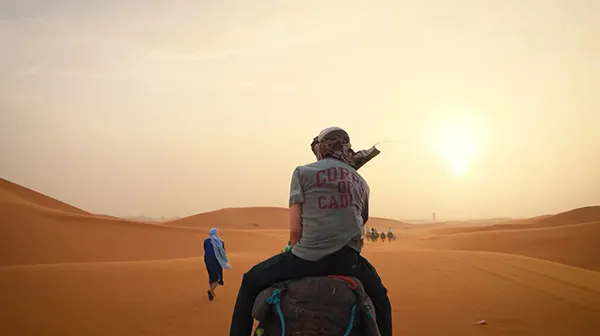
She says the moment changed how she thinks about leading. “When I learned I just had to roll with the punches, that there’s a lot of things that I cannot control, and even though I had a plan, that plan didn’t go how I specifically wanted it. So, I just had to learn to rely on the people around me and just recognize and realize that not everything’s perfect,” says Cope.
The cadets leaned on one another throughout. “I watched one of our cadets here take work that fell through the cracks at the very end here and turn it into probably three of the most fun days I had in Morocco,” says Lavecchia.
Diplomacy and Lessons in the Margins
Not every highlight came with a view. For C/1SG Sean Cavanaugh ’28, the expedition’s cultural officer and a Marine Option midshipman and studies in war and peace major, the most memorable moment came at a fort, where the team met with the Royal Moroccan Armed Forces at the Military History Directorate and was introduced to the general who ran the installation.
“The fort was definitely my favorite experience,” says Cavanaugh. “And it helped me really see what diplomacy was like in a sense, in a very light manner.”
He sees it as an experience only a student could have. “It helped me out tremendously because I got to meet and interact with a foreign military general twice as a cadet. You know, there’s room for mistakes and there’s room for learning, but if I was a captain, for example, meeting a foreign general for the first time, there’s a lot more expectations,” says Cavanaugh.
Garcia describes another lesson that grew out of Morris’s guidance: thinking about the periphery, and about the things that go unsaid. During a visit to southern Morocco to learn about Amazigh culture and politics, the cadets focused on the people in front of them.
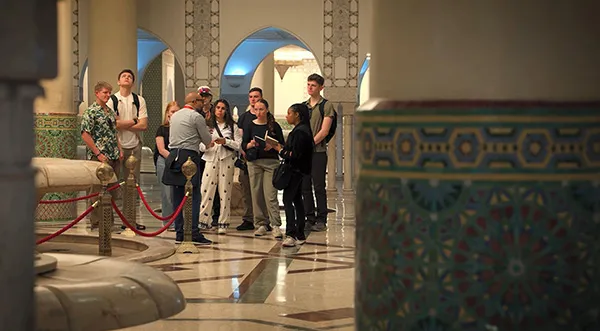
“For example, when we visited the South and saw the Amazigh people and learned about their culture and politics, we focused primarily on that throughout the day, and we didn’t really discuss what we were seeing around us that wasn’t being said, that wasn’t being discussed, such as reservoirs, water resources, things like that, that really go deeper into what’s actually happening in the region,” says Garcia. “As a future leader, it is crucial that we have the ability to see and understand things that are not being directly spoken to or told to us.”
The Human Perspective
Alongside the high-level meetings, the cadets took in the everyday life of the country. “The biggest thing that’s going to stick with me is the Medinas,” says C/1LT Megan Sweeney ’27, a cyber major and Air Force contracted pilot select who served as a logistics officer. “I thought it was really beautiful. And I think if I were to live over here, I’d be in the Medina every day.”
For Cope, some of the most lasting moments were shared in a kitchen. The group spent time with the Amazigh people, who are indigenous to Morocco, and cooked tagine and couscous together. “I feel like cooking is very intimate. At home, I cook with my mother. It was a great experience to be able to share with someone else and even bring what I made home so that I can cook it with my mother,” she says.
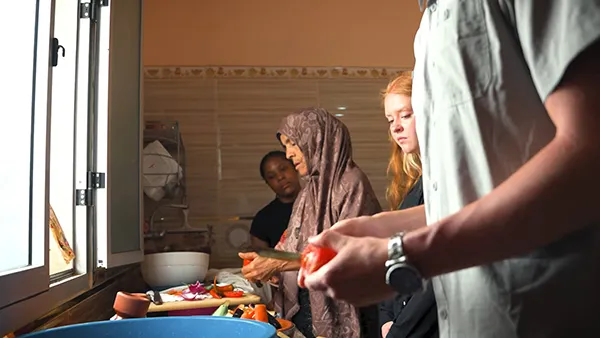
C/PVT Kristian Adlianitski ’27, a Marine Option cadet and cybersecurity major and the team’s analyst officer, says that kind of connection is what separates the expedition from a vacation. “It’s such a good opportunity to attend this trip with a lot of these cadets, work together, not just come for a tourist trip, not just come and do tours, but meet with these people,” says Adlianitski.
Through the Lens
Documenting all of it was Harry Dwinell, senior videographer in the Marketing and Communications Office and a drone professor, who traveled with the team. His approach was to be a “fly on a wall” and stay out of the way and let the story unfold.
“I try to never stage anything but to simply film what is unfolding in front of me,” says Dwinell.
Because the pace of the trip left little room for sit-down interviews, he pulled students aside during their downtime so he would not pull focus from the experience itself. The video, he says, “came secondary to them experiencing all they could on the trip.”
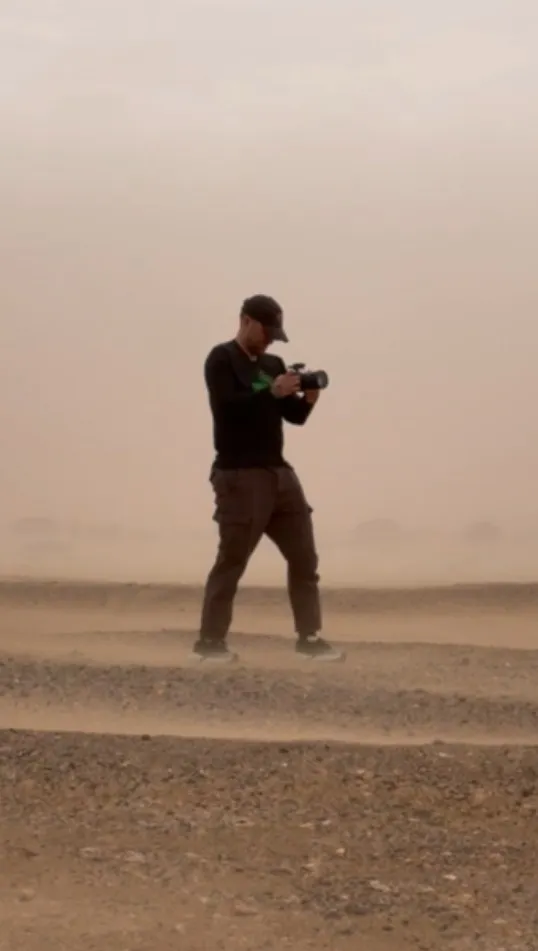
From behind the camera, Dwinell watched the team grow. Each evening, the cadets and Morris held an after-action review, going around the group to share what they had seen. “The biggest growth I saw was in the understanding of their own observations,” says Dwinell. By the end of the trip, he says, the cadets had become better at sharing facts before drawing conclusions. “This is a hard skill to learn, and I was quite proud watching them grow in this way.”
He built the video around “the idea of a mosaic,” says Dwinell, rather than a linear narrative, so viewers could take in what the students saw, smelled, and felt. The work was personal for him, too. A former Peace Corps volunteer in The Gambia, Dwinell says the chance to return to West Africa was “an absolute dream.”
The Norwich Reason
For some cadets, the Olmsted Expedition was a goal long before they set foot in Morocco. Lavecchia, an Army ROTC cadet and studies in war and peace major, says the trip was part of why he chose Norwich in the first place.
“The Olmsted Expedition is actually one of the things that pulled me to Norwich. For me, this was my first time outside of the Western world and being able to say that I went somewhere and did something that I probably wasn’t comfortable with two or three years ago,” says Lavecchia.
He says the lessons are ones he expects to carry into any career. “It also gives us a framework for how to build proper teams, right?” says Lavecchia. “The skills that we learn here are going to translate wherever we go, whether that be as an officer in the military or somewhere in the corporate world, in the government world.”
C/SFC Brendan Macking ’28, a Navy Option cadet the finance officer and a mechanical engineering major, says the lack of hand-holding is part of the value. “I’d say it gives us a lot of confidence in doing everything and anything in our future careers, because we’re not always going to have guidance and we’re not always going to be told exactly what to do,” says Macking.
Leaders by Design
For Morris, the stakes of that preparation extend far beyond graduation. “Each student, each cadet, is going to be a leader, and they have no idea just how many people that they’re going to lead,” says Morris. “We want them to have all the tools necessary to be resilient, to have empathy, to be critical thinkers, to be engaged, but also to be effective leaders, and that doesn’t happen by chance.”
The cadets understand it. “Norwich is forever. Norwich men and women are forever. Experiential learning is also forever,” says C/PVT Adrianna Barrera ’27, enlisted USMC, 1371 combat engineer, the team leader and a political science major. “And it’s a ripple effect. So, starting with something like Olmsted, if we didn’t have the ability to plan it ourselves, then what would we be doing? We’d be like every other school.”
Lavecchia puts the lesson of Morocco in words he credits to his father. “One of the lessons that my dad always taught me was seek first to understand and then to be understood, and I think that is at the very core of this trip, at the very core of leadership.”
Read More
S-STEM Scholars on the National Stage
By Dr. Darlene Olsen
Norwich faculty and students take their talents to the nation's capital during the S-STEM Scholars meeting.
2 min read
Norwich hosts Vermont ASCE Geo-Institute meeting
By Dr. Michael Gangone
Norwich University brings Vermont engineers, faculty, and students together to explore geological challenges, emerging technologies, and advances in geotechnical research.
1 min read
Learning in the Field
By Dr. Michael Gangone
Engineering students take their learning into the field as they visit major infrastructure projects.
2 min read