
Norwich cuts ribbon on Cyber Fusion Research and Development Center
Norwich University opens the latest state-of-the-art facility on campus.
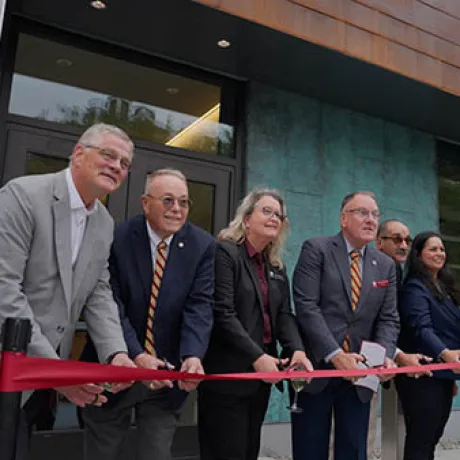
Norwich University marked the official opening of its Cyber Fusion Research and Development Center (CFC) last week with a ribbon-cutting ceremony celebrating a facility years in the making. University leaders say this will position Norwich at the forefront of the country's cybersecurity and technology challenges.
The 13,000-square-foot center, built with $16.4 million in congressional directed spending secured by retired Sen. Patrick Leahy, brings cybersecurity, advanced computing and artificial intelligence together under one roof with faculty, students, military partners and industry professionals.
LtGen John Broadmeadow '83, USMC (Ret.), 25th President of Norwich University, told the gathered crowd that the building had existed only on paper for a long time and thanked Vermont's congressional delegation along with state and local officials for their support in bringing the project to completion.
LtGen Broadmeadow said the idea for the CFC predates its construction timeline, growing out of a simple question: what would it take for Norwich to lead in the technologies of the future? University officials wanted to ensure that students across all disciplines — not just those studying cyber — could tap into the digital revolution and contribute to the nation's defense.
"This facility greatly enhances Norwich's pursuit of that goal," said Broadmeadow.
The center houses an event space alongside research and development labs, fusing disciplines that once sat in separate buildings, Broadmeadow said. That integration matters, he added, because the problems graduates will face rarely respect academic boundaries.
"An attack on a power grid is at once an engineering problem, a criminal investigation, an intelligence question and a communication challenge."
A letter from Leahy, long known as Vermont's "Cyber Senator," was read aloud during the ceremony. Leahy and his wife, Marcelle, congratulated the University on the opening at the start of the academic year, writing that they anticipate a year of advancement for Norwich students and the positive change they will make in the world.
"This center will be an innovation hub that will merge the latest technology and techniques with the timeless values of the University," wrote Leahy. "I anticipate that the multidisciplinary connections made in this building between researchers and industry throughout Vermont will lead to great progress."
Dr. Tara Kulkarni, associate provost of research and chief research officer at Norwich, said the CFC is a resource for the entire University community, not solely those in cyber-related fields. She said Norwich needs its disciplines working together to ensure graduates leave as scholars and citizen-soldiers equipped to work through difficult scenarios.
LtGen Broadmeadow closed by calling the center a representation of the future, one that will shape how students confront the challenges facing the nation and the world in the years ahead.
"The things that are going to happen in this building will impact generations to come," he said.
Designed by Jones Architecture — the firm behind Mack Hall and the Kreitzberg Library — the CFC includes a Security Operations Center, collaborative workspaces, classrooms, and specialized labs, along with a large open meeting area equipped with projection, audio, and video conferencing technology. The building is designed to bring together cybersecurity, advanced computing, criminology, communications and geointelligence, giving Norwich faculty and students the ability to work alongside staff from the Norwich University Applied Research Institutes (NUARI) and partners across the private sector, military and government.
The CFC extends a legacy that dates to 1999, when Norwich launched one of the nation's first cybersecurity-focused degree programs, Computer Security & Information Assurance. Since then, the University has grown its footprint in the field through NUARI, the Center for Advanced Computing and Digital Forensics, and its role as a founding member of the National Cybersecurity Preparedness Consortium. Norwich has also established the DoD Cyber Institute, developed the DECIDE® cyber exercise platform, launched a GenCyber summer camp for high school students, and created a dedicated learning center for artificial intelligence, machine learning and quantum computing.
With the ribbon now cut, the Cyber Fusion Research and Development Center opens its doors as a purpose-built space for turning cybersecurity education into hands-on practice — preparing the next generation of leaders to defend the systems the world increasingly depends on.
Read More
Architecture in Action: Students Present During Homecoming
By NU Marketing & Communications Office
Architecture students present their work during Homecoming, one of the University's busiest weekends on campus.
2 min read
2026 Military Writers’ Symposium: How Cinema Shapes Our Perception of War
By Zack Bennett
Two days of programming on media and war features student research, expert panels, and a look at Darby’s Rangers.
3 min read

School of Architecture and Art to host John Cays
By NU Marketing & Communications Office
A subject-matter expert brings his expertise to Chaplin Hall on the Northfield campus.
2 min read