
Lighting the Lantern
A College of Graduate and Continuing Studies student and service member reflects upon his unique path to a Norwich degree as a distance learner, highlighting how his experiences taught him to both lead and succeed as a citizen-soldier.

My name is PO1 Nick Clayton '26, U.S. Navy. I am a husband, a father of three girls, an active-duty service member, and a distance learner.
When I first got the call about sharing my Norwich experience, my reaction wasn’t excitement, it was disbelief.
I kept thinking, I wasn’t the typical Norwich student. I didn’t spend four years walking the UP. Much of this degree happened in uniform, late nights online, between missions, or at the kitchen counter after putting my kids to bed.
While what I share today reflects only my personal experience and not the official views of any organization I serve, it is a story that I know is shared in different ways by many of you here.
At my command, our seal includes a lantern, a nod to Paul Revere’s “one if by land, two if by sea.” Originally, I saw it as a historical homage. Over time, my perspective shifted.
That lantern isn’t about seeing everything ahead. It’s about choosing to move forward when you can only see a few steps in front of you, and carrying light anyway. In many ways, that represented my time at Norwich.

Our courses did not hand us ready answers. They gave us principles and placed us in problems that were messy, partial, and unsettled. At the time that felt stressful; looking back, that discomfort was the point, because it mirrors the world we’re graduating into.
Most problems today aren’t clearly defined. Information is incomplete, time is tight, yet decisions are necessary. Often, all you have is a lantern.
I felt this most clearly in two moments.
First, I stepped out of writing a paper on a policy issue and into a working group dealing with that exact problem. In class I had space to think; in the room there was no pause button. It was a trial by fire in applying theory to practice.
I realized leadership often doesn’t look like a spotlight; it looks like holding a single lantern, seeing only what you need to see, and still taking responsibility for the next step. Theory only matters if it works when reality gets complicated.
Second, I wrote a discussion post that didn’t align with my professor’s position. The challenge wasn’t disagreement; it was how to express it with care and evidence. In that moment, the lantern wasn’t about lighting a problem. It was about carrying the torch of truth.
That became a lesson in speaking truth to authority, not theatrically, but principled and respectful. It wasn’t on the syllabus, yet it’s a lesson I’ll carry long after today.
When I step back, both experiences say something similar.
In these moments, progress doesn’t come from imitation or waiting for commands. It comes from people willing to think differently and collaborate. We also learned that constraints don’t limit us; they often disguise opportunities that force creativity.
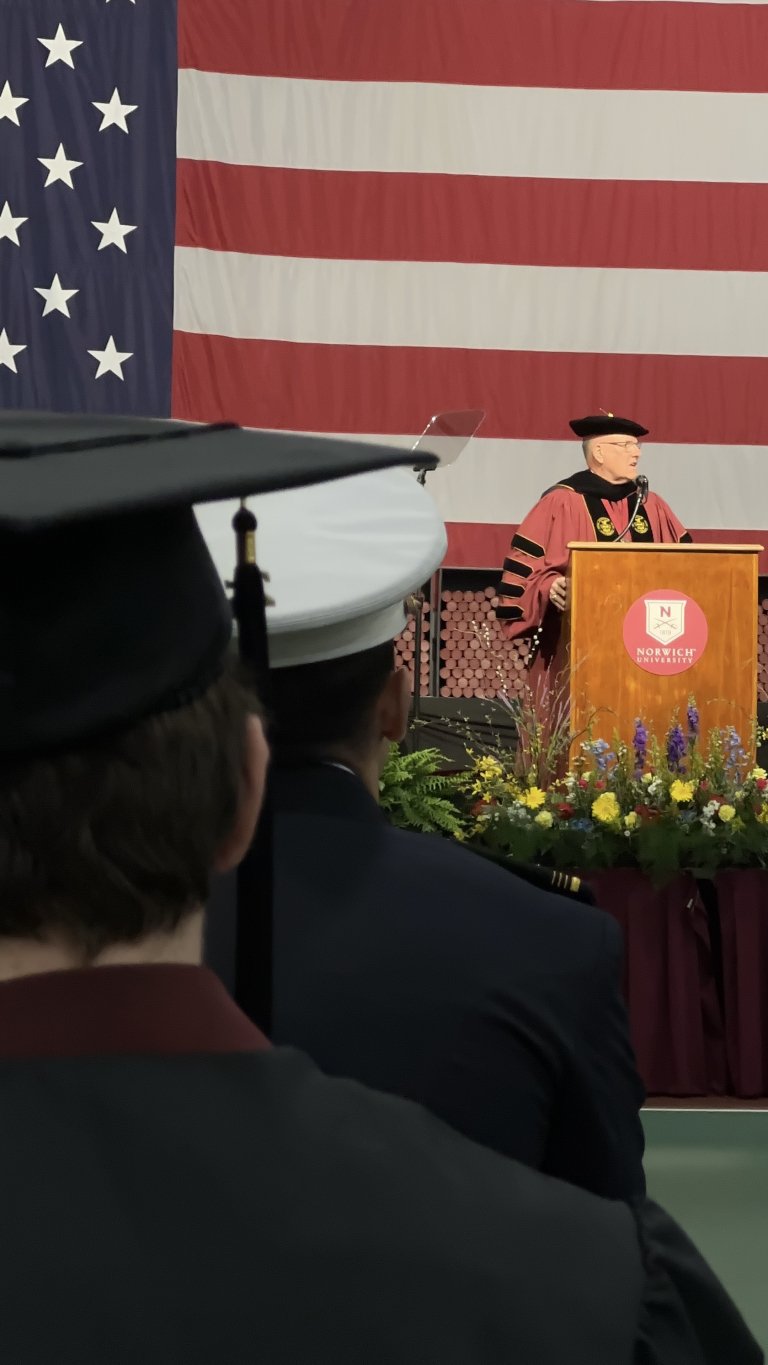
We came here from very different places: Corps and civilian students, online learners, parents, service members, working professionals, all carrying our own lanterns. That shared experience gives us illumination.
It also raises a harder question we’ll all face: How do you take responsibility for a problem you didn’t create, and still commit to solving it, even if you won’t benefit?
Norwich didn’t give us certainty. It gave us practice thinking in conditions where that question matters.
We didn’t just succeed when things were clear. We kept going when information was convoluted, time was tight, and answers conflicted. That should give us confidence, not because we have all the answers, but because we know how to approach problems worth solving.
So today, I don’t imagine a perfectly lit future.
I imagine each of us stepping forward with a Norwich-forged lantern, shaped by different paths, but carried with shared responsibility.
Norwich didn’t give us certainty. It gave us practice in moving forward anyway.
And after what we’ve done here, that feels like the right trade.
Class of 2026, keep your lantern lit.
Read More
Celebrating the Women of 1976: From Pioneers to the Old Guard
By Women Kicking Glass Campaign
Fifty years after becoming Norwich’s first class of four-year female graduates, the women of 1976 will make history again when they receive the maroon and gold medallions of the Old Guard.
4 min read
NY Army Guard Major General Michel Natali retires after almost 40 years of service
By Eric Durr
This link takes the reader to an external article.

Norwich hosts AWS Generative AI Challenge for senior military colleges
By NU Marketing & Communications Office
Student teams from five institutions tackle a connected-vehicle cybersecurity case in annual competition.
3 min read