
Cyber Rally: The Comback
Five students turn an early setback into a victory built on teamwork as Norwich rallies from last place to win cyber defense competition at Texas A&M.
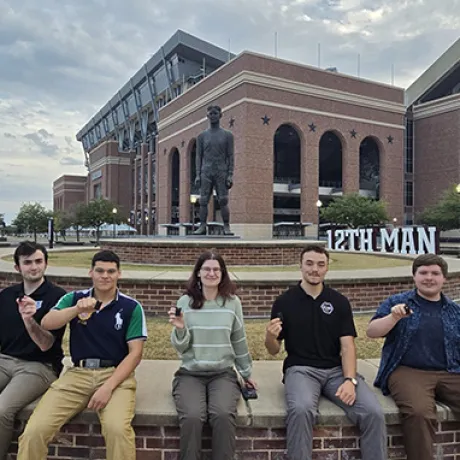
Norwich University’s five-member cyber defense team climbed from last place to victory at Texas A&M University, winning a seven-hour competition that tested its ability to keep a computer network running under sustained attack.
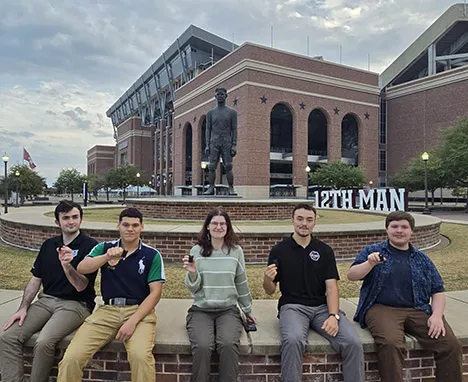
Norwich took first place among six Senior Military College teams at the Texas Cyber Defense Challenge in College Station, Texas, on Nov. 7, 2026. Representing Norwich were Gordon Leaver, Gian Criollo-Rivera, Holly Smith, Cameron Sousa and David Palmisciano.
“Entering an active triage event can be confusing and disorienting, and our team started in last place,” Holly Smith reflected. “However, once we found our footing, working together became easier as we climbed the ranks and ultimately won the competition, beating second place by just 200 points.”
Hosted by the Texas Cyber Range and Texas A&M Cybersecurity Center, the event required students to defend a live network against cybersecurity industry professionals serving as an attacking “Red Team.” Rival student teams could also launch attacks within the competition’s rules, adding another source of pressure.
The challenge began with trouble already inside the network. Organizers designed the exercise around an assumed breach, with attackers able to plant malicious software before competition began. Defenders had to investigate compromised systems and remove threats while keeping essential services available.
A fictional digital museum gave the technical work a recognizable purpose. Each team was responsible for keeping its exhibits and supporting systems online as attackers tried to disrupt them. The scenario celebrated America's 250th anniversary and Texas A&M's 150th, but the demands on students were practical: diagnose problems, secure systems, and restore access without creating new failures.
Service availability accounted for 80 percent of the score, with automated checks every 30 seconds. The remaining 20 percent came from business and operational assignments issued during the contest. Students had to balance immediate technical emergencies with other work under deadlines. Chaperones could not coach or guide their teams during competition.
For Norwich, that pressure made coordination essential. Smith credited the victory to the team’s ability to combine technical knowledge with collaborative problem-solving.
At Norwich, the Senator Patrick Leahy School of Cybersecurity and Advanced Computing houses the Cyber Leader Development Program, which offers experiential opportunities, including competitions, internships, and research, that connect academic study with practical work.
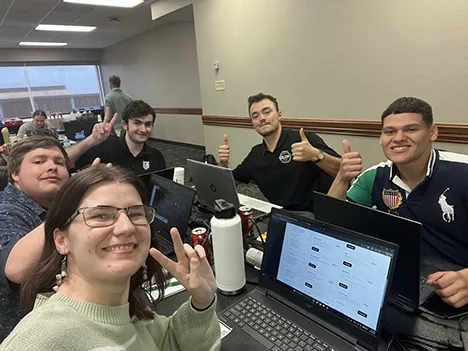
Each member of the winning team received a digital encryption key. For Smith, the lesson behind the victory was how the five students supported one another under pressure.
“Being able to problem-solve collaboratively and support each other in keeping systems running was the reason our team won this competition,” she wrote.
The “win” is true to Norwich’s deepest experiential learning tradition, now in the digital age. Our founder, Captain Partridge, would be proud that we are carrying out his vision in 2026.
Read More
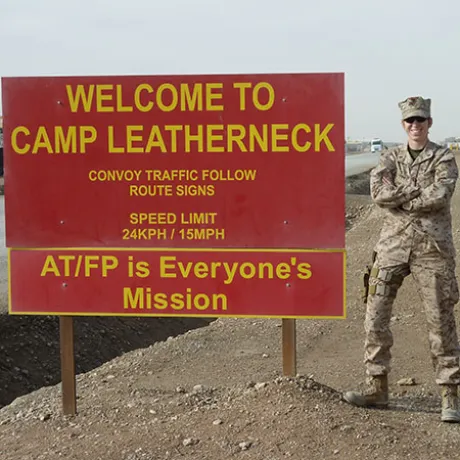
The Marine Scholar: Valerie Cranmer's Journey Through Military History
By Joshua Leonard
From Marine Corps intelligence operations to doctoral research and a postdoctoral appointment at Columbia University, Norwich alumna Valerie Cranmer, MMH '21 has built a career connecting military experience with historical scholarship.
11 min read
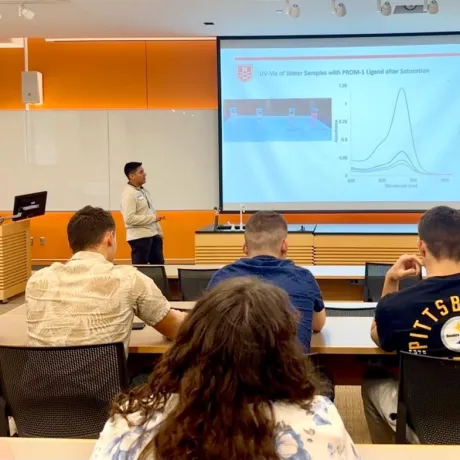
Norwich University Undergraduate Researchers Present at Regional Chemistry Symposium
By Dr. Emma Barrett
Norwich students take their research projects to a regional symposium for presentation.
2 min read
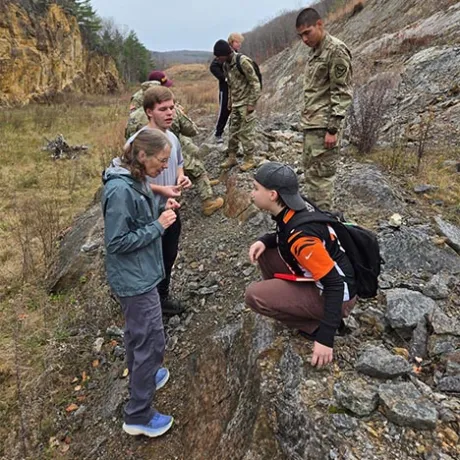
Partridge School for Outdoor Learning Students Hit the Road
By Dr. Laurie Grigg
The first cohort of the Outdoor School live Captain Alden Partridge's vision more than 200 years after institution's founding.
1 min read